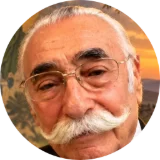
This text is one of Seyit Derviş Tur Dede’s writings on the Alevi faith. For a general introduction: What is Alevism? Its faith, history and core values
Esteemed friends of the Ehl-i Beyt (Ahl al-Bayt, the family of the Prophet)! The month of Muharram is, for the friends of the Ehl-i Beyt, the month of worship and of mourning.
It is very sacred to us. May the blessed month of Muharram be auspicious for us all. I greet you all with love for the Ehl-i Beyt. On this first day of Muharram I shall try, as far as my humble tongue allows, to set out in summary the sacred values of Imam Ali, the forefather of the Twelve Imams, of the month of Muharram and of the Muharram fast.
Bismillahirrahmanırrahim. (In the name of Allah, the Most Gracious, the Most Merciful.) Bismişah Allah, Allah: I begin in the name of almighty Allah, who forgives and who judges, and with the blessing (himmet) of the Prophet Muhammad and the Ehl-i Beyt. Allahumme salli ala Seyyidine Muhammed ve ala Ali Seyyidine Muhammed. (O Allah, bless our master Muhammad and the family of our master Muhammad.) Laa ilahe illallah, hak birsin Muhammed’e Resulullah Ali yün Veli’yullah, Ehli Bey’i kerem- ullah, şefaat kıl ya Resulullah! (There is no god but Allah; God is one, Muhammad is the Messenger of Allah, Ali is the Friend of Allah, the Ehl-i Beyt is the generosity of Allah – grant intercession, O Messenger of Allah!)
My almighty Allah, who rules over this entire universe! Blessings and peace be upon Your Ehl-i Beyt, whom You praised in the Holy Qur’an in verse 23 of Surat al-Shura and verse 33 of Surat al-Ahzab. Selamullah ya Hüseyin (God’s peace be upon you, O Hüseyin). Selamullah ya Hüseyin. Selamullah, O martyrs who fell thirsting at Karbala:
O my almighty Allah! Thanks and praise be to You for granting us to keep this Muharram fast and the mourning for Karbala. Blessings and peace be upon Your prophets, Your erenler (perfected friends of God) and Your saints (evliya). May the souls of the martyrs of Karbala be gladdened by Your divine light. Curse be upon Yezid (Yazid), his lineage and his way of thinking.
For the sake of the souls of the martyrs of Karbala, do not let us stray from righteousness and from the right path. Do not let our path fall to the pathless or our cause to the unjust, O my Lord!
For the sake of this holy day, do not turn away empty-handed from Your presence us, Your believing, Muslim servants, who in this gathering have kept their fast, opened their hands before You, prayed, asked for forgiveness and made known to You their requests and wishes, O my Lord!
O my almighty Allah! We are Your servants, the community (ümmet) of the Prophet Muhammad, devoted to the Ehl-i Beyt; You alone we serve, from You alone we expect help, of You alone we ask forgiveness. If, knowingly or unknowingly, we have fallen short towards You or rebelled against You, forgive us for the sake of Your name, You who are the Most Gracious and the Most Merciful, O my Lord!
O my almighty Allah, who created this universe! Turn the hatred of all these people of ours into love, their greed into compassion, their enmity into peace, and grant them to live as brothers and sisters in an atmosphere of friendship, O my Lord!
For the honour of the Three, the Five, the Seven, the Twelve Imams, the Fourteen Pure Innocents (14 Masum-u Pak), the Seventeen Kemerbest (the Girded Ones) and the Forty, do not make us dependent on the worthy or the unworthy. Grant us abundant sustenance by lawful means, O my Lord! For the sake of the dear soul of Hünkâr Hacı Bektaş Veli, do not give us an affliction for which we must search in vain for a cure; give a cure to our affliction, healing to our sick, health to our souls and happiness to our homes, O my Lord!
For the sake of the dear souls of the erenler and the saints, accept in Your glorious presence the fasts we have kept, the lokma (consecrated food offerings) we have given and the prayers we have said, O my Lord! Do not let our efforts be in vain. Do not deprive us of the intercession of the Prophet Muhammad, nor of the company and sight of the Ehl-i Beyt, of their path and their erkân (rites), O my Lord! We dedicate the fasts we have kept and the prayers we have said to the souls of the Prophet Muhammad and his Ehl-i Beyt. Accept them in Your glorious presence. Illuminate the souls of the martyrs of Karbala with Your divine light and reward them with Your intercession, O my Lord! Selamullah ya Hüseyin, selamullah ya Hüseyin, selamullah, O martyrs who fell thirsting at Karbala. Nuri nebi, keremi Ali, gülbangi Muhammedi. (The light of the Prophet, the generosity of Ali, the prayer of Muhammad.) The words are ours, the blessing is Imam Hüseyin’s, the help is almighty Allah’s. Gerçeğe Hüü, Mümine ya Ali. (Hu to the Truth, ya Ali to the believer.)
The sacred value of Imam Ali:
Imam Ali is the Veliyullah (Friend of God) who was born inside the Kaaba. Why do the Alevis love Imam Ali so much? First, he is the son of the Prophet Muhammad’s uncle. Of the same lineage, the same blood, he is the Ruh-u Veliyullah (the spirit of the Friend of God), who came into the world inside the Kaaba, the house of Allah. And in his outward aspect: the Prophet Muhammad raised and educated him with his own hand. He received his knowledge from the Prophet Muhammad. What the Prophet Muhammad said about Imam Ali, and who Imam Ali was, you will find in all the historians of Islam, even if in different wording. Verse 67 of Surat al-Ma’ida, revealed in the region of Ghadir Khumm (Gadir Hum), gives this command: “O Prophet! Proclaim what has been sent down to you from your Lord. If you do not do so, you will not have delivered His message. Allah protects you from the people. Truly, Allah gives no opportunity to the unbelievers.”
Upon this command sent by Allah, the Prophet Muhammad appoints Imam Ali as caliph, deputy and executor (vasi) of the religion of Islam after him. I described this event at length in my previous talk. Look at what this short text taken from the sermon of Ghadir Khumm (Kadiri Hum) says:
“O people! Know that Allah is my mawla (master). And I am the mawla of all believers. Whoever’s mawla I am, Ali too is his mawla. Whoever loves Allah loves me. Whoever loves me loves Ali too. Whoever is an enemy of Allah is my enemy too. Whoever is my enemy is Ali’s enemy too. O Lord! Love those who love Ali. Be the enemy of those who are Ali’s enemies. Help those who help Ali. Despise those who despise and insult Ali. Ali’s flesh is of my flesh. Ali’s blood is of my blood. Ali is in me, I am in Ali. The Truth (Hak) is always with Ali. For he, together with me, represents my Ehl-i Beyt. O Lord! Protect him from all evil.” This and similar sermons were proclaimed in accordance with the command of verse 67 of Surat al-Ma’ida. That means that Imam Ali took over the office from the Prophet Muhammad by Allah’s command.
Surat al-Shura, verse 23: My beloved, tell your community: for bringing you this true religion I ask no wage of you. I ask only pure love and loyalty (biat) towards my Ehl-i Beyt. God forgives those who walk on His path and bestows favours on them.
Surat Al Imran, verse 110: “O Ehl-i Beyt of Muhammad! You are a good community brought forth for mankind, enjoining what is right, forbidding what is wrong and believing in Allah. Had the People of the Book believed, it would have been better for them.”
Let us now consider: our Prophet said so many words of praise and value about Ali that one could never finish counting them. One day the companions asked the Prophet Muhammad: “O Muhammad, after you, from whom and from where shall we learn the knowledge of Islam?” Look at what the Prophet Muhammad says: “I am the city of knowledge, Ali is its gate. Whoever wishes to come to me to learn knowledge, let him go first to Ali.” Twenty-four articles of the decrees that Imam Ali wrote to his governors during his caliphate were taken over word for word into the European Universal Declaration of Human Rights.
When you examine the book “DER IMAM” written by the professors who wrote the Universal Declaration of Human Rights – look at what the professors who wrote it say about Imam Ali: “The Islamic world has presented Ali wrongly. When we studied Ali, it became clear that he was a philosopher so enlightened and just that he sheds light from that day to this.” The Alevi faith was brought forth with Imam Ali, and its belonging is Ali’s. If you ask for the identity (künye) of Alevism, it is Imam Ali.
To regard Imam Ali, in terms of faith and knowledge, as equal to the other caliphs or to Muawiya is betrayal and denial of the religion of Islam brought by the Prophet Muhammad. If a person does so unknowingly, may Allah forgive him. But if he does so knowingly, one must doubt his belief and faith. Such people – let alone calling them Islam – cannot even be called Muslims. Now let us also look at how Hazrat Mevlana (Rumi) presents Imam Ali.
KASIDE-NAT-I ALI – Ode in Praise of Ali (by Hazrat Mevlana)
I begin in the name of the merciful God who has compassion on all. That revealing Imam, that Friend of God, is the sun of the existence of the people of purity (sefa ehli). The essence of that Imam, who stands with God (Hak) on earth, in heaven, in space and in time, must necessarily be characterised by inner and outer purity. For he is freed from unbelief and hypocrisy; he is pure. His dwelling is the world of unity. He is beyond worldly and human attributes. He was like the truth and the soul of man. Everything is perishable, but the soul lives and does not die. His movement comes from the pre-eternal being that is alive of itself. He circles in the sphere of permanence (beka). His creatures are everlasting like the essence of the Creator. The exalted attributes of God are the attributes of Ali. Inside the Kaaba he took on human form and came into the world as Ali. The attributes of God are in any case not separate. He has clung to the essence of God and has become it. Is there not that hidden treasure of Lahut (Lâ Ut, the divine realm) of which you have heard? That is he.
For he appeared from God, through God. The coin of that treasure was inexhaustible knowledge. And by that knowledge is meant the exalted Ali. No one but he can know the wisdom of God. For he is the wise one, he is the knower of all things. The First without beginning was he. The Last without end will also be he. It was he who helped the prophets, and he is truly also the seeing eye of the friends of God. The luminous radiance of his face created a sun in its own light.
He is with God; God appears through him. By God, he is eternal with God. Adam’s clay was in his light. That is why he became the crown of the angels. The names of Allah became manifest through him. Thanks to the knowledge of that pure and exalted Imam, Adam understood all things. Because that light is the light of the one Creator, the realm of the angels (Melekût) prostrated before him. Yes, surely Adam knew all the divine names through the light of that Imam. Seth (Şit) saw the light of Ali within himself and came to know the exalted world.
Noah (Nuh) always found everything he sought through him, until he raised himself to the exalted station. Again it was through him that Noah, who attained salvation, found in the river the flood of zeal and was delivered from calamity. The Prophet Halil (Abraham) remembered him in friendship, and the fire became for him a red tulip. Nimrod’s fire became, for that friend of Allah, all roses, narcissi and tulips. Again it was he who, at his pleasure, offered his own sheep as a sacrifice for Ismail. Joseph (Yusuf) remembered him in the well and found the throne that adorns the realm of sovereignty. Jacob (Yakup) lamented before him, caught the scent of Joseph, and his eyes were opened.
Moses (Musa), son of Imran, saw his light and was lost in wonder for long nights. For forty nights he was beside himself; he was immersed in the delight of union and encounter. Then he said: O Lord! Give me a sign of this grace. God said to him: Behold, I have given you the Yed-i Beyza, the luminous hand. Again it is the love of Ali that became Mary’s (Meryem) companion, and so Jesus (İsa) came into being. In the sharia he is the gate of the city of knowledge. In truth (hakikat), however, he is the lord of the two worlds. The sultan of the two worlds, Muhammad, at the degree of nearness to God, in the sacred precinct of union with Allah, saw his secret. He heard Ali’s speech from Ali. In that place where one becomes one with Ali, no one is found but Ali.
Those who walk on Allah’s path are seekers; Ali is the one sought. Those who speak, speak and fall silent. He does not fall silent; he speaks. Eternal knowledge shone and became visible in his breast. He knew the secrets of what was revealed as truth and made them known. He called out to the communities: “On Allah’s path Ali is your guide.” Those whose hearts are sincere towards Allah have turned their faces to him; he is the shah. He is the one who shows the right path, he is the master. He was in the secret of all the prophets. His Excellency Mustafa says: “He was openly together with me.” In religion he was the first and the last. He was intimately one with Allah.
I have said these things so that you may learn the subtlety of this exalted meaning and attain exalted velayet (friendship with God). Let it be plainly known to you that it is he who is truly exalted. O sir (efendi)! Do not quarrel with me in vain; it is so, this is the truth: we are all specks of dust, the sun is he. We are all drops, the sea is he. For God, in the Qur’an, describes Himself as Ali (the Exalted).”(*) Presenting Imam Ali in this way, “Mevlana” expresses his account with thanks and praise.
So exalted, then, is the virtue of Ali. Well, I leave it once again to the conscience of my readers: can such an Imam Ali be held equal to the other caliphs or to the companions? If loving Ali is irreligion, let earth and heaven bear witness: I am irreligious, son of the irreligious. I wonder whether I have been able to make myself understood?
That is why the Alevis love Imam Ali more than the other caliphs and companions. I want to ask you: should the Ehl-i Beyt – whom the Prophet Muhammad praised so highly and about whom verses were revealed in the Qur’an – and Ali, a member of the Ehl-i Beyt, not be loved? As Mevlana says: “He is the Veliyullah who has become Truth with the Truth.” That is why the chief architect of the Alevi faith is Imam Ali and the Ehl-i Beyt. In their worship, their prayers and their gülbanks (ritual blessing prayers), the Alevis always remember Imam Ali, the Ehl-i Beyt and the Twelve Imams together with the Prophet Muhammad.
Source
(*) Hazrat Mevlana’s work “Selected Poems from the Divan-ı Kebir” was translated from Persian into Turkish by Mr Mithat Bahari. It was printed in a second edition of 5,000 copies in the Classics of Eastern Islam Series (Şark İslam Klasikleri Serisi) by order no. 19622 of the Publications Directorate of the Ministry of National Education dated 10.07.1963. All printing and publication rights belong to the Ministry of National Education. This Kaside Nat-ı Ali appears on pages 3–5 of the selected poems section of this book.
The Sanctity of the Month of Muharram
The month of Muharram is the first month of the Hijri calendar. In Persian the tenth day is called “aşure” (Ashura). Aşure means “ten”. In the Alevi faith there is a ten- or twelve-day Muharram fast that is identified with the events of Karbala. This fast and the mourning (matem) for Karbala have become so fused that many Alevis keep this fast. They keep the mourning together with the fast they observe. But they do not know that the two have different characteristics. When asked, they say that they keep both the fast and the mourning in order to experience and keep alive the pain of the martyrs of Karbala. They cannot distinguish what they do and why; that is why, in this account, I shall try to explain what we do and why.
According to historical sources, long before Islam the tenth day (Ashura) of the month of Muharram was a common value regarded as sacred by the Arab, Israelite and Persian peoples. Histories attribute the value and sanctity of this day to its being the day on which many prophets attained salvation and deliverance. Out of love and faith in their prophets, people sanctified this day. That is why the prophets who came before the Prophet Muhammad also fasted on this holy day to express their thanks and praise to almighty Allah, cooked the soup of salvation of the Prophet Noah and fed the poor. To win Allah’s good pleasure they gave charity and alms. The Prophet Muhammad and Imam Ali too fasted for 10 days in Muharram, cooked their soup and gave charity and alms. All histories express the sanctity of Muharram in this way for the period up to the events of Karbala.
- One day for the day on which the repentance of Father Adam was accepted,
- one day for the day on which the Prophet Abraham (İbrahim) did not burn in Nimrod’s fire,
- one day for the day on which the Prophet Noah’s ark found land,
- one day for the Prophet Moses’ delivering his people from the evil of Pharaoh and for his thousand and one conversations with Allah,
- one day for the day on which the Prophet Jonah (Yunus) was saved from the belly of the fish,
- one day for the day on which the Prophet Job (Eyüp) found a cure for his afflictions,
- one day for the Prophet Jacob’s being reunited with his son, the Prophet Joseph.
- Five days for Imam Zeynel Abidin’s (Zayn al-Abidin) being saved alive at Karbala. With this it comes to 12 days, out of love for the 12 Imams.
The fast kept in Muharram! It is a fast of thanks and praise that all past prophets attained salvation and deliverance and that, with Imam Zeynel Abidin’s being saved alive at Karbala, the lineage of the Ehl-i Beyt continues to exist in the world. Fasting is the most sacred act of worship.
Of course there are also the days on which many other prophets attained salvation and deliverance. But these are the values the historical sources give us. Together with this fast of thanksgiving, kept from the 1st to the 12th of Muharram, we also keep the mourning. Of the 72 martyrs who fell at Karbala, 19 – from Imam Hüseyin to six-month-old Ali Asgar – are of the lineage of the Ehl-i Beyt. They were martyred on the 10th of Muharram, the day the Qur’an calls holy. And so, together with the fast of thanksgiving kept in Muharram, we also keep the mourning for the martyrs of Karbala. Let us see what the Qur’an says about the 10th of Muharram: verse 39 of Surat al-Rahman. This verse was revealed in Mecca before the Hijra. “On that day neither man nor jinn will be asked about his sin,” it says. After Surat al-Rahman was revealed in Mecca, the Prophet Muhammad and Imam Ali kept their fast from the first to the tenth of the month of Muharram. They cooked Noah’s soup of salvation and gave charity and alms.
This verse sets out the sanctity of the 10th of Muharram, the day of Ashura, clearly and plainly. For the Alevis, the 10th of Muharram has a second sanctity as well. The events of Karbala took place precisely on this holy 10th of Muharram. What verse 39 of Surat al-Rahman expresses – “On that day neither the people who die nor the jinn will be questioned” – is evident. And it was on that very holy day that the beloved grandsons of our Prophet were martyred.
For this reason the tenth of Muharram, the sanctity of mourning, has a value in the hearts of the Alevis that we cannot express in words. That is why the days from the 1st to the 13th of Muharram are days of grief and mourning. Together with the mourning held in memory of the martyrs of Karbala, a fast of thanksgiving is kept for ten or twelve days. The first reason for this fast is the remembrance of the prophets described above. A second reason is that, while all the male members of the Ehl-i Beyt were being martyred at Karbala, Imam Hüseyin’s eldest son, Imam Zeynel Abidin, was saved alive because he was gravely ill and his father did not give him permission. The imams and seyyids, the descendants of the Prophet, continued from Imam Zeynel Abidin. As an act of worship expressing thanks and praise to Allah for the continuation in the world of the lineage of the Prophet Muhammad and the Ehl-i Beyt, a fast of thanksgiving is kept for twelve days, out of love for the Twelve Imams.
This means that the Alevis perform the worship of fasting as thanks and praise both for the prophets’ attaining salvation and deliverance and for the Prophet’s lineage not being cut off in the world but continuing. Up to this point we have related with what belief and conviction the Alevis believe in the events that took place in the month of Muharram. Now let us also look at the Qur’an. What does the Qur’an say about the Muharram fast?
The Sanctity of the Muharram Fast According to the Holy Qur’an
Verse 183 of Surat al-Baqara says exactly this: “O you who believe! Fasting has been prescribed for you on a counted number of days, as it was prescribed for the People of the Book before you, so that you may guard against opposing Allah.”
Verse 184: “Whoever of you is sick or on a journey, let him fast the same number of other days as the days he could not fast. Those who have an excuse not to fast, who cannot endure it, let them give, for each day, a ransom (sadaka) sufficient to feed a poor person. Whoever does good, that good is for himself. That you fast is better for you, if only you knew.”
Hazrat Mevlana, in the Masnavi, volume 2, page 460, “The Legends of the Gnostics (Arifler)”, relates as follows: “The Commander of the Faithful, Imam Ali – may God be pleased with him –
had followed Muhammad Mustafa in the ten-day fast of Ashura. Like the Prophet, Imam Ali ate nothing at all during the nights of the fast. The Prophet Muhammad looked at Imam Ali and saw signs of weakness in him. Thereupon he said to Imam Ali: “I am not like one of you.” But from God’s side, I too am a human being like you. The difference is: “Strength and power are given to me by way of revelation (vahiy),” he said. In the Holy Qur’an, verse 6 of Surat Fussilat commands: “O Muhammad! Say to them: I too am a human being like you. It is revealed to me that your God is one God; I act by the command of that God.” It is clearly seen from the source given by Hazrat Mevlana that the Prophet Muhammad and Imam Ali fasted for 10 days in the month of Muharram. On the 10 nights of Muharram on which the Prophet Muhammad and Imam Ali fasted: Qur’an rendering by Abdulkadir Gölpınarlı, Surat al-Fajr (Fecr), verses 1+2: “By the breaking dawn and the ten nights”. In the rendering of İsmail Hakkı Baltacıoğlu: “For the sake of the ten nights”. In the rendering of Yaşar Nuri Öztürk: “By the ten nights”. Qur’an rendering of the Maarif Library, Surat al-Fajr, verse 2: “By the dark 10 nights”. Bedri Noyan Dede Baba’s Turkish Qur’an rendering in verse, Surat al-Fajr, verses 1+2: “Look at the dawning of the day, look again at the ten nights”. In İsmail Hakkı İzmirli’s Qur’an rendering, Surat al-Fajr, verse 2: “For the sake of the ten nights”. And in the Qur’an rendering of the Diyanet (Turkey’s Presidency of Religious Affairs), verse 1: “By the breaking of the dawn”.
As the result of all the research, the Prophet Muhammad and Imam Ali kept their fast in the first ten days of the month of Muharram. When we examine the Qur’ans available to us, we find no outstanding holy event in the month of Dhu’l-Hijja (Zilhicce). Yet in a single edition of the Diyanet it is written: “By the first 10 nights of the month of Dhu’l-Hijja”. According to all the research it is known that the holy month is the month of Muharram. For in the time of the prophets who came before the Prophet Muhammad, the month regarded as holy was Muharram. It was only after the coming of the Prophet Muhammad’s prophethood and after the Hijra, with the revelation in Medina of verse 185 of Surat al-Baqara, that the month of Ramadan too came to be regarded as holy. I have not found the sanctity of the month of Ramadan before the religion of Islam in any history book, and you will not find it either. But all histories write that before the religion of Islam the holy month was Muharram.
I wish to submit the following to the attention of today’s religious scholars and scientists: the massacre of Karbala was committed on precisely this holy day. The religion brought by the Prophet Muhammad remained, after the four caliphs, for a full 86 years in the hands of these enemies of Islam, these false Muslims. Moreover, attaching the label of the Prophet Muhammad with fabricated hadiths to every infamy and betrayal they committed – saying it was the sunna of the Prophet Muhammad – they reorganised the religion of Islam according to the beliefs of their own Jahiliyya era. Of course, on this blessed holy day they killed the Prophet’s children with the most merciless, inhuman cruelty. Naturally they cannot say of the day on which they committed the massacre: this is a holy day. Had they not abolished the sanctity of Muharram, the whole Muslim world might have risen up. For would people not ask: “How can you wage war on such a holy day, in the month in which war is forbidden, on this blessed day and in this month whose sanctity is expressed in Qur’anic verses? And on top of that murder the children of our Prophet Muhammad, from whom we expect intercession!” Would they not ask? Would they not rise up? Because they saw this danger, they had the bought scholars of the time say that these verses referred to the month of Dhu’l-Hijja or to Ramadan.
They even gave the name of the month of Dhu’l-Hijja to the 10 nights of Muharram sanctified by Surat al-Fajr. They had it said that verse 183 of al-Baqara, which was revealed for the Muharram fast, had come for the Ramadan fast. From that day until today it has remained so – but why is there a wish for it to continue so? This I want to ask today’s religious scholars. You have nothing to do with these enmities and betrayals that were committed. Why do you still perpetuate these errors and slanders? Why do you honour Muawiya and Yezid, the enemies of the religion of Islam, by calling them “Hazrat”? Why do you not tell people the truth?
When we look at world history, there have been similar betrayals and errors in the past of many nations. Yet we see that those peoples do not now persist in the same errors or the betrayals committed. They find what is most correct and suited to the conditions of the day and apply it. Why do we Turks not rescue this religion of ours, which for years has groaned under the dominion of the betrayal and errors that the Arabs applied? Why does one section of those who still consider themselves Muslims go so far as to despise, humiliate and even kill another section for irreligion? How much longer will this blindness, this betrayal go on?
Please let us try to understand this verse 183 very well. Look at what it says: “O you who believe! Fasting has been prescribed for you on a counted number of days, as it was prescribed for the People of the Book before you, so that you may guard against opposing Allah.” Now please think carefully. The tenth of Muharram and the month of Muharram became sacred even before the Muslim religion came, because it was the day on which the prophets of the past attained salvation and deliverance. When we look at what the Qur’an says, it was prescribed for all the past prophets. And it states clearly that afterwards it was also prescribed for the Prophet Muhammad and his community. The Prophet Muhammad and Imam Ali, while still in Mecca, after the revelation of Surat al-Rahman, also performed this worship every year from then on. So the obligatory (farz) fast spoken of in verse 183 is the fast kept in the month of Muharram.
Before the fast of the month of Ramadan had even been commanded, the Prophet Muhammad is said to have withdrawn into seclusion in the cave of Hira in the month of Muharram and completed the worship of fasting. At the end he is said to have cooked the Prophet Noah’s soup of salvation and fed the poor. The word “Savm” occurring in the Meccan suras means in Turkish “Sükût” (silence), that is, not uttering a word – which means cutting off contact with people and worshipping. For the idolatrous Arabs too there is no source at all that they fasted before Islam. However, some people of the Quraysh (Kureyş) are said to have withdrawn, in the Jahiliyya era, for a period of one month in Muharram to Mount Hira as “Tahannus” (atonement for sins) and to have worshipped there [1].
Now this question comes to all our minds: which fast was prescribed for the prophets of the Book before Muhammad, of whom the Qur’anic verse speaks? The counted days from the first to the tenth of Muharram? Or the Ramadan fast made obligatory by verse 185 of Surat al-Baqara, revealed in Medina after the Hijra, after the Prophet Muhammad had made the Ascension (Miraç) and returned? The Qur’an states that Surat al-Baqara was revealed in Medina. The Prophet Muhammad’s Hijra from Mecca to Medina dates to 621 in the Gregorian calendar. It can be seen that the verse prescribing the Ramadan fast came after the Hijra. The sanctity of the month of Muharram goes back to much earlier times. Verse 183 states it very clearly: “O people! Fasting has been prescribed for you on a counted number of days, as it was prescribed for the People of the Book before you, so that you may guard against opposing Allah.” I am of the conviction that interpreting this verse, revealed for the Muharram fast, as referring to the Ramadan fast is a betrayal of the Qur’an and of Islam. If we consider the Ramadan fast:
According to the Qur’an, the month of Ramadan became sacred because it is the month in which the first revelation came to the Prophet Muhammad. For that reason the Qur’an indicates that it is a holy month. Scholars and historians, on the other hand, relate that Abu Sufyan marched on Medina in the month of Ramadan with an army of 3,000 men to destroy both the Prophet Muhammad and Islam. The Prophet Muhammad had been in Medina for only a year; he had neither soldiers nor an army. Yet with a gathered civilian community of 300 people of complete faith, and by the strength of almighty Allah, he destroyed Sufyan’s armed army of 3,000 men. Many of the leading idolaters of Mecca lost their lives in this Battle of Badr. The Prophet Muhammad won his first victory in the month of Ramadan. That is why historians and scientists say: “Had the Battle of Badr in Ramadan not been won as a miracle, there would otherwise have been neither Muhammad nor the religion of Islam. That is why the month of Ramadan became sacred.”
Now let us also see what the Qur’an says about the sanctity of the month of Ramadan and its fast. Surat al-Baqara, verse 185, commands exactly this: “The month of Ramadan is that in which the Qur’an was sent down as guidance for people and as clear proofs distinguishing right from wrong. Whoever of you witnesses this month, let him fast in it. Whoever is sick or on a journey, let him fast the same number of other days as the days he could not fast. Allah wants ease for you, not hardship. He has made these eases lawful so that you may glorify Him for having guided you. Perhaps you will be grateful.” If you pay attention, the wording of the verse revealed about the Ramadan fast and of the verses revealed about the Muharram fast are very different from each other.
In the verses revealed about the Muharram fast it says: “O you who believe! Fasting has been prescribed for you on a counted number of days, as it was prescribed for the People of the Book before you, so that you may guard against opposing Allah.” This verse is solely for the Muharram fast.
Verse 185, revealed for the month of Ramadan and its fast: “The month of Ramadan is that in which the Qur’an was sent down as guidance for people and as clear proofs distinguishing right from wrong. Whoever of you witnesses that month, let him fast in it.”
In summary, I have written down the commanding sentences of the verses revealed about these two fasts, which carry different wording and meaning; the rest is detail. These verses, which give different messages with different wording, were merged – by resorting to a pseudo-lawful trick (hile-yi şer) – onto the Ramadan fast. Their aim was to abolish the sanctity of the month of Muharram and of the Muharram fast. If you ask why: to legitimise the massacres and the enmity that Muawiya, the accursed Yezid and Marwan – and thus the Umayyads – committed against the lineage of the Prophet Muhammad and against Islam during their 86-year caliphate.
Of course, both of these fasts are obligatory (farz) fasts proclaimed by Qur’anic verses. Believing people can have no objection to them. However, the Alevis do not keep the Ramadan fast for 30 days. Conscious Alevis fast for three days, before and after the Night of Power (Kadir Gecesi). They do not celebrate the Ramadan Feast (Ramazan Bayramı) at all. The reason! I explained very clearly and plainly on 08/08/2020 when recounting the event of Ghadir Khumm. I do not consider it necessary to explain it again. The Sunnis, for their part, do not fast in Muharram. They do not keep alive the memory of the massacre committed at Karbala against the children of our Prophet. They have never been seen to hold a mevlid, an act of worship or a day of remembrance. Only some families cook aşure (Ashura pudding) in that month, even though they do not know the day and its meaning. When we ask, they say: “My mother used to cook it and told us: you too should cook it every year, it is meritorious – and so we cook it.” This is how the Umayyads turned the religion of Islam brought by the Prophet Muhammad upside down in an unbelievable way. Those whom we curse are the Yezids of that time, who betrayed the lineage of the Prophet Muhammad and committed the massacre of Karbala. Today’s society has absolutely nothing to do with this statement.
I call upon our Alevi community. Fasting is the most sacred act of worship. Today is the first day of the month of Muharram and of its fast. Let us cherish such sacred values of ours. In all our cemevis and everywhere, every evening at the fast-breaking services, the value we should hold dear is to bring joy to a poor person, an orphan. Seek out poor families, find them and help them. This is a sacred service. My words are addressed to the Alevis who believe and have faith: at your fast-breaking table set aside a share for someone in need, give them a place. Gladden the heart of the poor and the orphan, make them happy, so that the fast you keep and the prayer you say may be accepted before God. O my Lord, we dedicate the fasts we have kept and the prayers we have said above all to the souls of the Prophet Muhammad, his Ehl-i Beyt and the martyrs of Karbala. Accept them in Your glorious presence. Do not let our efforts be in vain; do not deprive us of the intercession of the Prophet Muhammad, of the path and erkân of the Ehl-i Beyt, O my Lord. With love and affection (Aşkı Muhabbetle). Delivered on Düzgün TV on 20/08/2020.
Kürreyi arz’sın habibi kibriyasın ya Hüseyin
Nuri çeşmi şahi Merdan Mürtazasın ya Hüseyin
Hem ciğer paresin Fatima’tul Zöhre hayri nisasın
Ehlibeyti müctebayı Ali’yi Ebasın ya Hüseyin
You are the globe of the earth, you are the beloved of the Almighty, O Hüseyin,
the light of the eye of the King of the Brave, Murtaza, are you, O Hüseyin,
the darling you are of Fatima al-Zahra, the best of women,
the chosen of the Ehl-i Beyt, of Ali of the Mantle (Ali-yi Aba), are you, O Hüseyin.
(Vedduha Velleyl) denildi validen hakkında çün
Cüzü Kuran, zatı padişahı enbiyasın ya Hüseyin
Sana didayı gül ile dokunan hiç umarmı mağfiret
Goncayı gülşen sarayı M. Mustafasın ya hüseyin
Since “Wa’d-duha” and “Wa’l-layl” were spoken concerning your father,
you are a part of the Qur’an, the essence of the sovereign of the prophets, O Hüseyin.
Can one who touches you even with a rose-glance ever hope for forgiveness?
The rosebud of the rose-garden palace of M. Mustafa are you, O Hüseyin.
Ehli mahşer desdi Haydar’dan içerken kevseri
Sen susuzluk’dan deşti Kerbelasın ya Hüseyin
Sedhazaran lanet olsun ol Yezidin canına
Nice kıydılar sana Nuri hudasın ya Hüseyin
Kıl şefaat Arife ceddin Muhammed aşkına
Arşı mahşerde makbuldür rican senin ya Hüseyin
While the people of the Last Judgement drink Kawthar from Haydar’s (Ali’s) hand,
you are the one parched with thirst on the plain of Karbala, O Hüseyin.
A hundred thousand curses be upon the soul of that Yezid!
How could they slaughter you – you are the light of God, O Hüseyin.
Grant intercession to Arif, for the love of your forefather Muhammad;
at the Throne on Judgement Day your plea is accepted, O Hüseyin.
Table Prayer (Sofra Duası)
Bismillahirrahmanırrahim, Bismi Şah Allah, Allah.
(In the name of Allah, the Most Gracious, the Most Merciful; in the name of the Shah, Allah, Allah.) My almighty Allah, who created this whole universe: for granting us to keep this Muharram fast and the mourning for Karbala, thanks and praise be to You. Blessings and peace be upon Your prophets, Your friends, Your erenler and Your saints. May the souls of the martyrs of Karbala be illuminated by Your divine light and rewarded with Your intercession, O my Lord. For the sake of the souls of the erenler, the saints and the martyrs of Karbala, accept in Your glorious presence the fasts we have kept, the lokma we have given and the prayers we have said, O my Lord.
Elhamdülillah, Elhamdülillah, Elhamdülillah (praise be to Allah). May it be the table of the erenler, the lokma of the pir. May it be lawful (helal) for those who eat, and for those who gave to eat may it be a lokma of God for the souls of the martyrs of Karbala. This has gone; may its abundance (gani) return. May Hak-Muhammed-Ali grant its blessing. Wherever it has gone, may no grief or sorrow enter. May the hands and feet of those who earned and brought it, who cooked and laid it out, see no affliction, and may their hearts see no sorrow. May the exalted Mevla grant us the wishes of our tongues and the desires of our hearts. May almighty Allah, who created this universe, not let our efforts be in vain, and accept in His glorious presence our prayers and the lokma you have given to eat. O my almighty Allah! The lokma we have given and the prayers we have said we also dedicate to the souls of the martyrs of Karbala and of all the martyrs who gave their lives for the salvation of humanity; accept them in Your glorious presence. Gladden their souls and make Paradise their abode. O my Lord! The words are ours, the help from Hüseyin, King of the Martyrs of the plain of Karbala, the intercession from the Prophet Muhammad Mustafa. May the acceptance of our prayer be from almighty Allah. Praise be to Allah, Lord of the worlds. Blessings and peace be upon His prophets. Esselatu vesselam aleyke ya Resulullah. Esselatu vesselam aleyke ya Hüseyin’i deşti Kerbela. (Blessings and peace be upon you, O Messenger of Allah. Blessings and peace be upon you, O Hüseyin of the plain of Karbala.) For the right of the lokma, for the honour of the table, for the generosity of the erenler, for the breath (dem) of the generous. Gerçeğe hüü mümine ya Ali. (Hu to the Truth, ya Ali to the believer.)
Prayer of Intention for the Muharram Fast (Niyet Duası)
“Bismillahirrahmanırrahim. Bismi Şah, Allah, Allah! Praise be to Allah, Lord of the worlds. Blessings and peace be upon all His prophets. May the souls of those martyred in the lineage and on the path of the Ehl-i Beyt be gladdened. O my almighty Allah! For granting me to keep this Muharram fast and the mourning for Karbala, thanks and praise be to You. I have made the intention, for the sake of Allah’s good pleasure, to keep today’s Muharram fast and the mourning for Karbala. O my Lord, make me one of those who are patient; accept my prayer and my fast in Your exalted divan. Gerçeğe Hüü …
[1] History of Islam (İslam tarihi), vol. 1, p. 202. Prof. Dr Philip K. Hitti. Translated by Prof. Dr Salih Tuğ.
THE PHILOSOPHY OF SUFISM: Be precious like water!
The lesson to be drawn from the nature of water:
Think of water flowing down from a mountain! To flow, it chooses the path of least resistance. What if an obstacle or a rock appears in its way? It does not give up its path; it does not struggle with the rock. It does not fight the rock, but flows around it and continues on its way. Inspired by this nature of water, the Sufis say: “Do not struggle with the people who struggle with you. If you struggle with them, you remain in the same place with them. Go around them and continue on your way.”
Suppose a great rock appears before water flowing from a mountain. And there is no way to flow around it either. What does it do then? It gathers, collects, grows and passes over the top of it.
And if that too is not possible, it patiently tries to bore through the rock drop by drop. It is not the strength of the water that bores through the rock, but the persistence of the drops. And this is called patience.
To be patient does not mean to sit still in one’s place doing nothing. Patience! It is being able to imagine the rose within the thorn, the day within the darkness of the night.
The nature of water teaches that one can achieve even the impossible, and how right it is to be patient and steadfast for this.
The water that has bored through the rock of course continues on its way again. Water always flows, is in motion and works. It knows that as it flows it is cleansed and it cleanses. Sometimes pools of water form in little ponds. Water that does not flow grows murky and dirty. If it waits a long time in that pond, filth gathers on it, it turns to mud and begins to stink.
That is why the erenler and the Sufis say: Do not grow dirty like the water in the pond. Flow constantly like running water; renew yourself every day, always. Do not let two of your days be the same. Always forward, always renewed; leave yesterday to yesterday, see to learning something new. Water is never afraid of movement, of flowing, of change.
But people, even if they say they love change, are in fact very afraid of it. If we think of the transformation of water! Sometimes it becomes rain, sometimes snow, sometimes ice. Sometimes it becomes vapour and rises to the sky, becomes rain, becomes snow, comes down to earth and becomes water. In its essence nothing changes. Everywhere it is clear and transparent; it does not change its colour. It shares. It nourishes. It nourishes people, animals and nature. It is the primary source of everything living and non-living. It is the strongest producer. Wherever there is water, there is life. It is because of this natural being of water that the erenler and Sufis say to one another: “Be precious like water.”
Shams-i Tabrizi (Şems’i Tebrizi)
Further articles on Alevism
Faith and erkân
- What is Alevism? (main page)
- What does Kızılbaş mean? Who is called an Alevi?
- The Four Gates and Forty Stations in the Alevi faith
- What is ikrar, and where does it come from?
- Islam and the Alevi faith
- The meaning of the word Islam and its distortion
- The place of women in the Alevi faith
- The Fourteen Pure Innocents and the Seventeen Kemerbest
Cem and rites
- What is a Cem? The cemevi, Cem rules and the twelve services
- What is the semah? The sanctity of the semah
- What is musahiplik, and where does it come from?
- The görgü rite (görgü cem)
- Funeral rites among Alevis
- The marriage rite among Alevis
- What is düşkünlük?
Feasts, fasts and holy days
The Twelve Imams
- Who are the Twelve Imams?
- Imam Ali
- İmam Hasan
- İmam Hüseyin
- İmam Zeynel Abidin
- İmam Muhammed Bakır
- İmam Cafer-i Sadık
- İmam Musa-i Kâzım
- İmam Rıza
- İmam Muhammed Taki
- İmam Ali Naki
- İmam Hasan Askeri
- İmam Mehdi
The Seven Great Poets (Yedi Ulu Ozan)
- Who are the Seven Great Poets?
- Seyyid Nesimi
- Şah İsmail Hatayi
- Fuzuli
- Yemini
- Virani
- Pir Sultan Abdal
- Kul Himmet
- Noksani Baba
History: Ahl al-Bayt, Ghadir Khumm and Karbala
Books and Alevi organisation in Europe
- Erkânname
- The first Alevi organisation in Europe (memoirs)
- Alevi İslam Şah’a Giden Yol (book)
- All books
German: Alevitentum: Grundlagen, Glaube und zentrale Begriffe · Geschichte der Aleviten-Organisation in Deutschland
About the author: Seyit Derviş Tur Dede
Born in 1936 in Başköy (Çayırlı, Erzincan) into a seyyid family belonging to the Babamansur (Şah Mansur) ocak. He is a co-founder and the first chairman (1990–1993) of the Federation of Alevi Communities, the forerunner of the Alevi Federation of Germany (AABF). From 1994 to 2003 he chaired the federation’s Council of Dedes. He is the author of the books Erkânname (2002) and Avrupa’da İlk Alevi Yapılanması (The First Alevi Organisation in Europe, 2016); his work is cited as a source in academic publications by researchers such as Martin Sökefeld, Zeynel Gül, Burak Gümüş and Bülent Keleş.
Translated from the Turkish original by Seyit Derviş Tur.