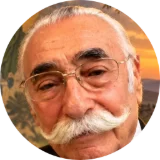
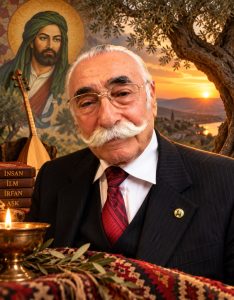
THE LIFE STORY OF SEYYİD DERVİŞ TUR
According to the civil registry, I was born on 10/11/1936 in Başköy, in the Çayırlı district of Erzincan. On both my father’s and my mother’s side, my parents belong to the lineage of Şah Mansur (Baba Mansur). My father, Seyyid Haydar Dede, is the grandson, in the fourth generation, of Seyyid Keko the Rehber. My mother, Elif Ana, is the daughter of Seyyid İbrahim, the elder brother of Seyyid Kasım of the Şah Mansur ocak (a holy lineage whose members serve as spiritual guides), from the village of Gelengeç in Çayırlı. Although our lineage originally spread out from the village of Moğundu in the Mazgirt district of Tunceli, it appears that our great forefathers settled in these regions at least fifteen generations ago. Until 1939 my grandfather and my father rendered religious services to the talips (lay followers bound to an ocak) in these regions. At the time of the 1939 Erzincan earthquake we were living in Başköy. I remember it very well, as if it were today.
Six months after the earthquake we moved to the village of Mitini, which belongs to the central district of Erzincan. Between 1944 and 1949 I attended primary school in Mitini. During the nearly 12 years we lived in Mitini, my father Haydar Dede would begin the cems (Alevi worship ceremonies) every year in the ninth month. The Nevruz cem on 21 March was the last cem of the year. 90% of these cems were held as görgü cems (cems of accountability, in which the community examines the conduct of its members). The religious foundation of my childhood was laid in these cems.
After our family moved to Ankara in December 1950, we kept the religious services alive in Ankara as well, even if not to the same extent as in the village. From 1951 to 1954 I received vocational training, working for three years in the automobile repair section of the Military Heavy Maintenance Apprentice School. After that I worked as a mechanic in private repair shops in Ankara. On 25/08/1955 I obtained my driving licence. While I was working as a taxi driver, I married on 23/04/1956. I drove a taxi until I went to do my military service. On 20/09/1957 I was called up for military service. I did 45 days of basic training at the military training centre in Manisa. Because I held an Ankara driving licence, they sent me as a driver to the Istanbul garrison commander, Lieutenant General Hayati Ataker. I completed my military service by serving as the general’s driver for two years.
After returning from the army I worked as a taxi driver in Ankara for a while. In April 1961 I started work in the machinery section of the Machinery Supply Department of DSİ, the State Hydraulic Works. While working in the machinery section of the State Hydraulic Works, I was attending the evening school of Yıldırım Beyazıt High School. My aim was to become a mechanical engineer. During this time unskilled workers were continuously being sent to Germany. I too considered it several times. But my position at work was very good; I was the foreman of the diesel pumps, Caterpillar and General Motors engines section. For that reason I did not really want to go to Germany. But unfortunately it was written in my fate: my late elder brother Kasım came home on leave from Germany. Although he knew that my job was good, he advised me to come to Germany and persuaded me. After that my brother Hüseyin, who worked at the Ford factory in Cologne, applied for me and helped me come to Germany.
Contents
- My Arrival in Germany
- The Work We Began for Our Ehl-i Beyt Alevi Islamic Faith
- The Decision to Found an Association
- Our Journey to Austria
- The Decision to Found a Federation
- The First Association Founded under the Name “Alevi” in Narlıdere, İzmir
- Taking the Problems of the Alevis to the Demirel Government
- How the Federation Passed to the Cologne Team
- The Founding of the Council of Dedes
- The Founding of the AABF Funeral Assistance Fund
- The Founding of the Alevi Academy
- The Karbala Pilgrimage
- My Attendance at the Offenburg Congress of Dedes
MY ARRIVAL IN GERMANY:
And so, in May 1966, I came as a worker to a factory producing tin cans in the city of Cologne in Germany. But I deeply regretted having come. The pay was less than what I had earned at the State Hydraulic Works in Turkey, and on top of that I was carrying cans for eight hours without a break. It hurt me deeply. That is how my German adventure began. In the end I had made up my mind: either I would find work in my own profession, or I would return to Turkey. Finally, in March 1967, my brother saw an advertisement in a newspaper: “Diesel engine repair master wanted.” He brought me the advertisement. We telephoned, and they gave us an address, saying: come on Saturday and let us talk. The address was a village called Hennef in the district of Siegburg. Taking with me my diploma and references, which I had had translated into German in Ankara, we went to the company address we had been given in Hennef. When the technical manager there read my documents, he said: fine, we will hire you. But I started work on the condition that if they were not satisfied with me within three months, they would dismiss me. I worked for three years at that firm, Alyos Gilyam, as a repair master for diesel engines and lorries. I have three sons: Yusuf and Kenan were born in Ankara, Turkey; Erdoğan was born in Siegburg, Germany. I also have seven grandchildren.
In the year 1969 Mr Nevzat, the owner of the Varan bus company in Turkey, reached an agreement with the airline EL.T.U and started workers’ flights between Düsseldorf in Germany and Istanbul at weekends, on Saturdays and Sundays. In 1969, while I was working in the repair shop, I had also begun selling plane tickets and export goods to Turkish workers in the workers’ hostels at weekends. Finally, in the second month of 1970, I resigned from the firm where I worked. From then on I devoted myself entirely to trade. In 1970 I opened a shop in a district called Dillenburg, in the name of the German woman with whom an acquaintance of mine lived. While I was running a business in Dillenburg for nine years, in 1972 my elder brother Kasım and I jointly opened a shop called Avrupa Galerisi (Europe Gallery) on Vali Konağı Street in Nişantaşı, Istanbul. When I was personally granted a trade licence in Germany in 1975, we closed the shop in Istanbul at the end of 1975. In 1977 we bought the house in Rüsselsheim in which we still live. But we only moved to Rüsselsheim on 02/03/1979. In the house we bought in Rüsselsheim we ran a food market, which also included a travel agency (Reisebüro) and the export business, until the 2000s. Everything up to this point was the work we did to support our family. Alongside this work, there was also the work we did in the spiritual sphere, for our faith, our philosophy and our culture.
All of us Turks had come with the intention of working in Germany for two or three years, earning some money, and then returning to Turkey. But it did not turn out as we had imagined. 95% of those who came did not go back. The only goal of those who stayed and worked in Germany was to save money. As the years went by, many of them brought their families and children. In this greed for earning money, nobody noticed how fifteen or twenty years had passed. The year had reached 1985. In Turkey, Kenan Evren had carried out his coup in 1980; most of the ’68 generation and the leftists of that time had settled in Europe. Leftist ideology in Europe was at the height of its influence. Many thoughtful people among the workers began to ask: what is our faith? In the future our children will not know their philosophy, their culture, their faith. The worry began to arise within the Alevi community about where our children would go and what they would become in future: Jehovah’s Witnesses, Sunnification, Catholicism or Protestantism? In 1984 it was said that 60% of the children under the age of 18 in the juvenile prisons of the state of North Rhine-Westphalia were Alevi children; this statement led thinking Alevis to act with even greater sensitivity in this respect.
THE WORK WE BEGAN FOR OUR EHL-İ BEYT ALEVI ISLAMIC FAITH
In the first month of 1986 we went to the wedding of one of our customers from Çorum in Rüsselsheim. A family we did not know came and sat down at our table. We introduced ourselves; the gentleman explained that he was from Çorum, a graduate of the Gazi Education Institute in Ankara and a teacher by background. I introduced ourselves as well. After getting acquainted, as we talked, we began with the question: what will become of Alevi children in Europe? But in the crowd of the wedding we could not talk much. We left the wedding together and came to our home. With the conversation about how, through what kind of work, we could bring the Alevi faith back to life within the Alevi community and how we could help Alevi children, the night had grown very late. As he was leaving, Mr İsmail said: in a month, when my brother-in-law comes, I would like to introduce him to you. Would you like that too? We said of course, we would gladly expect you, and saw our guest off.
One or two months passed, and Mr İsmail asked on the telephone: are you available, Mr Derviş, may we come to you this evening? When I said please, we will be expecting you, he came an hour later together with his brother-in-law. After exchanging greetings, they immediately said: what will become of the Alevi children? If the Alevi community goes on like this, it will lose its faith. A remedy must be found for this. But what can we do? Mr İsmail’s brother-in-law described the situation of the Alevi children in the prisons of North Rhine-Westphalia. Mr İsmail proposed the model of an association so that we could keep the Alevi faith alive in Germany. I said: let us not do it with an association; let us found a dergâh (a lodge, a spiritual centre) for the Alevi Ehl-i Beyt faith. My argument was that politics enters associations, and where politics enters there can be no faith; with this I opposed founding an association. Mr İsmail said: we have no dede to lead a dergâh, we have no knowledge; with whom would we run a dergâh? It is not possible. We can only found an association, and with that he persuaded me. We talked at length about how and with whom we would found it. In the end we reached the following decision.
Let us gather some Alevi canlar (fellow believers, literally “dear souls”) at a small meeting, explain our ideas and see whether the Alevi community supports us. Mr İsmail said: I know a teacher in Wiesbaden called Ahmet Aydemir. I will let him know, and I will bring a few people from Mainz. You gather a few people here in Rüsselsheim, and let us see what they say about our idea and act accordingly. In the end, on the date we had set, 23/02/1986, we met with 15 people beneath the café of my son Yusuf. All the canlar who came said: you have thought this through very well, all of us will help you. So we believed that this would continue. We parted with the decision that everyone should inform their own circle and that we would meet here again a month later.
THE DECISION TO FOUND AN ASSOCIATION
A month later we met in the same place with 70 or 75 people. With everyone sharing the same enthusiasm and the feeling “we are with you”, we took the decision to found an association. İsmail Yağlı, Ahmet Aydemir and Derviş Tur were elected to the founding executive committee. Veli Ocakloğlu was to help us with our German correspondence. Meanwhile we held many meetings; at the meetings we held, the constant pressure from our leftists, their sabotage of our meetings and their threats against us made us live through very difficult days.
In the end, on 01/12/1988, we officially founded the Mainz, Rüsselsheim, Wiesbaden Alevi Bektashi Association. From 1967 until 1991 we travelled to many provinces, gave seminars on Alevism and recommended and helped the founding of Alevi associations all over Germany. The associations that were founded and gained official status with our help were: Mainz, Frankfurt, Cologne, Dortmund, Kassel, Duisburg, Stadtallendorf, Heilbronn, Filderstadt — nine associations in total. We began to work even faster. Because we had caused these associations to be founded, we felt all the more responsible, and so we gave a seminar somewhere every week without stopping. The year was 1989, the second Hızır month (the month of the Hızır fast, in honour of Hızır, the saint who comes to the aid of those in distress). Ahmet Aydemir, İsmail Yağlı, Musa Bakır and I had gone to the Kassel association to explain Hızır and the Hızır fast. Most of the members of the Kassel association are from Erzincan. Another third are our canlar from Çorum. Another minority are people from other provinces.
The members of the Dortmund association are also mostly from Çorum. They are related to the people from Çorum in Kassel. They had heard that a seminar would be given about Hızır Aleyhisselam (peace be upon him). A large crowd had come from Dortmund to Kassel. After we finished our talks, we moved on to conversation. In the association there were members from Çorum, Erzincan, Hınıs in Erzurum, Tunceli and Sivas. During the conversation, as everyone said “the Alevism practised in our village or town is the true, 24-carat one”, a brief argument broke out between the people from Çorum and those from Tunceli. I was very saddened by this. Because we had a meeting in Heilbronn on Sunday, we had to return to our homes, even though it was late at night. We set off from Kassel in our car, with me driving, heading towards Frankfurt. “Because I was very saddened by that pointless argument,” I said: “Friends, we set out on this path to be of benefit to the Alevi faith and to the Alevis. Today I saw here that we will do more harm than good. Come, while the road is still short, let us close this Alevi matter. Did you not see? Everyone considers the Alevi sacred values they saw in their own home region superior to the others. If it goes on like this, the Alevi faith will be torn to pieces. If we do not found a higher body and gather the associations under one roof, we will do harm instead of good.” When I spoke like this, Musa Bakır said from the back: “President, the institution that creates the unity you describe is called a federation.” From then on, all the way to Frankfurt, we talked about the benefits of a federation. And so, that night, inside that car, the decision to found a federation was taken.
THE FIRST ALEVI SEMINAR IN THE MAINZ–WIESBADEN–RÜSSELSHEIM AREA:
While we were constantly giving seminars all over Germany in order to found Alevi associations, we had not yet held a single meeting or seminar on Alevi history or faith in the association we ourselves had founded. For this reason we decided to hold a seminar entitled THE HISTORICAL PAST OF ALEVISM at the Bürgerhaus in Astheim on 02/04/1989. After taking the decision to hold the seminar, we had leaflets printed and had them put into the letterboxes of all Alevi homes. Some political organisations that heard about it threatened us on the telephone one after another: “Do not dare to hold this meeting you have announced. If you do not listen and hold it anyway, we will bomb the place and turn it into a bloodbath. And you will be responsible for it.” Upon this, some of our friends on the committee wanted to give up. These friends did not even bring their families and children to the meeting. But İsmail Yağlı and I did not abandon the decision to hold the meeting. Whatever happens, we will hold this meeting, we insisted. It was I who had wanted this seminar to take place in the first place. I had even booked the hall myself. All the responsibility was mine. So I began to brood darkly. What if they raid the meeting and cause an incident? If someone is wounded or killed, how could I bear the burden of it? While I was brooding about what precaution I could take, I thought of İbrahim from Pazarcık in Maraş, who had a karate club, and of the family of Harabi Derin. They were our customers at both our travel agency and our market, and I knew them very well. I thought of going to them, and I went.
I caught both brothers together. I explained the situation to them. In the face of this situation I asked them to protect our meeting. Bless them, both brothers said: fine, we will protect it, but most of our black-belt karatekas are Sunni boys — would it be all right if we brought them? I said of course it would. Only, let everyone wear their white shirts and black belts as if they were stepping onto the mat, so that if they see beforehand that we have taken precautions, perhaps they will not dare. I told Harabi: put a karateka to the right and left of the man I point out to you. Instruct them: if the person standing near them or anyone else there behaves improperly, they should neutralise him and throw him out. The karateka Derin brothers did exactly as I had instructed and brought 14 young black-belt karatekas to the meeting. They stood like guards to the right and left of the people I had pointed out until the end of the meeting. There was no disturbance or incident whatsoever. But it is a very bitter thing: I was protecting Alevi mothers and fathers from Alevi children with the help of Sunni children. As the meeting was breaking up, the leader of those who had made the threats left, saying: “Derviş Tur, you wait, I will settle this account with you.” That man now goes around in the associations saying “I too am a dede”. This is how opportunists, mere caricatures of dedes, have sprung up. And now, with the name of Alevi and of dede, they lead uninformed young people astray. İsmail Tanyeli had come to this meeting of ours. At this meeting he made a request: “I have founded an association in Austria. But I have neither a dede to hold a cem nor anyone to explain Alevism. Would you help me?” And we had promised him: go and prepare, let us know, and we will come.
OUR JOURNEY TO AUSTRIA
Meanwhile, three weeks later, an invitation came from İsmail Tanyeli, dated 21/04/1989, asking us to hold a seminar and a cem at the Alevi association he had founded in the city of St. Pölten in Austria — with love, respect and greetings. On the back: “We ask you to hold a seminar on Alevism at our association on 12/05/1989 and a cem after it. We are expecting you here on that date.” I read the letter that had come at the committee meeting. No one objected, and we decided to go. While we were preparing to go, on Thursday 10/05/1989 there was a telephone call from my paternal aunt’s son in Austria, Alirıza Engin: “Uncle, a man from Erzincan called İsmail Tanyeli has opened an Alevi association here. He announced everywhere in writing that a group would come from Germany to hold a cem and explain the Alevi faith. Tonight a group of leftists who came from Vienna raided his house; if his sons had not arrived in time, they would have killed him. Now father and son are both wounded and in hospital. Uncle, whatever you do, do not come, do not put your lives in danger. And now they have distributed written leaflets to the houses saying: whoever goes to that cem will be carried out dead, because we are going to bomb the place.” I answered: all right, nephew, if the situation is this dangerous, perhaps we will not come either, and we hung up.
After this conversation, when I began to brood, my wife, Zöhre Hanım, noticed and asked insistently: what happened, who was on the phone? What she was thinking was that threatening calls were constantly coming from the left — was it one of them again? I told her: this call was from Alirıza, my aunt’s son in Austria; Alirıza says we should not come to Austria. My wife asked: why? When I told her what I had heard on the telephone, she thought for a while and then said: “Do not dare! Do not take a step back. So what? They also invited Hz. Hüseyin (Imam Husayn) to Kufa, and at Karbala they martyred him in order to destroy this faith. Is our blood any redder than the blood of Hz. Hüseyin? Had Hz. Hüseyin not given his head at Karbala, perhaps the Ehl-i Beyt faith would not have been kept alive to this day. They destroyed the physical body of Hz. Hüseyin, but they could not destroy his sacred value. As long as the world exists, the presence of Hz. Hüseyin will continue. If you take a step back here, the leftist faction will grow even bolder and will raid all our meetings in order to destroy us.” With these words she gave me courage.
After that my wife and I talked at length. İsmail Yağlı was the president of our association. I telephoned İsmail Yağlı and told him about the matter. İsmail Yağlı fell completely silent on the telephone. I waited for a long time; when I asked, “Mr İsmail, what do you say?”, he said: I don’t know, what have you decided? When I told him exactly what my wife Zöhre Hanım had proposed, Mr İsmail said: fine, Ana (Mother) has thought very well; let us not tell the friends who are coming about this situation. If some are frightened and do not come, our team will fall apart. Because we are going as two teams: a team to hold the cem and a team to give the seminar.
On Friday 11/05/1989 at eight in the morning there was a telephone call from Hasan Caner: “President, do not come to the city of St. Pölten in broad daylight. 40 km before St. Pölten there is a Shell petrol station on the road. We will wait for you there at 12 midnight; do not come early.” A week earlier we had decided here that on Friday everyone would gather at our place at 9 in the morning and we would set off. As a precaution I had wedged 9 pickaxe handles under the floor covering of the minibus I was going to drive. I had put them in the vehicle thinking that, just in case, if they blocked our way, we could at least defend ourselves with these sticks. We had prepared everything to set off. The call from Hasan Caner in Austria threw me. If I told the friends in the team going with us, most of them would give up and not come. Then we would not be able to go to Austria. I was calculating how I could keep the friends who had come occupied until 15:00 without letting them notice anything! Because by my calculation, if we left here at 15:00, we would only just reach the place where they were waiting at 24:00. Everyone came at 9 and was waiting for us to set off.
I told my wife: you see to preparing a meal. And to stall for time I said some business had come up and went down to the shop; in this way we stalled until 12 noon. When the movement of “come on, let’s go” began, we said: gentlemen, my wife has cooked a meal; let us eat our meal and then set off. So, without telling anyone anything, my wife and I kept them occupied until the time we wanted. As we were getting them into the vehicles, we divided them up: the team that would hold the cem and give the seminar would ride in my vehicle, and the women would ride in Gazi Dede’s car. Just as they were getting into my vehicle, my brother Hüseyin saw the pickaxe handles and asked: what are these sticks, brother? Because I had not expected such a question, I faltered at first. Then, in a reproachful tone, I said: the owner of the vehicle put them there, I don’t know, leave them where they are, what harm do they do — just get in — and closed the matter. Stalling in this way, we set off at 15:00. I was driving the vehicle, and Mr İsmail was sitting beside me in the front. After we had driven about a hundred kilometres on the motorway, Mr İsmail signalled to me: shall we tell them? I said all right. But how were we going to tell them! The canlar in the back had become absorbed in such a lovely conversation. Everyone was excited: in a short while we would be leaving Germany. So as not to spoil the conversation, we waited a little longer. I saw that the conversation had no end.
When I said, “Gentlemen, do you know that we are going to Kufa?”, the voices suddenly fell silent. Mr İsmail said: canlar, what of it — is our blood any redder than the blood of Hz. Hüseyin? They destroyed the physical body of Hz. Hüseyin too, but Hz. Hüseyin lives, and will live, as long as the world exists. Upon this, the questions began: what is it, what has happened? Mr İsmail said: let Derviş Dede answer these questions of yours, because he is the one who spoke to Austria on the telephone. I recounted exactly what I had heard and what I knew. Some said: why are we throwing ourselves into such dangers, couldn’t we just not go? But the majority supported us, saying that even if only out of defiance, we must go and hold this cem and this seminar. And so, at midnight, we arrived at the petrol station where they were waiting, and İsmail Tanyeli, having signed himself out of the hospital, with his head bandaged, had come with five cars and was waiting for us.
They put us in their own cars. They also took our vehicles away and hid them. They divided us among their homes. They took me to my nephew’s house. It turned out that my nephew lived on the floor directly above İsmail Tanyeli. Morning came, and I had only just sat down to breakfast when İsmail Tanyeli burst in in a panic: “President, they have planted a bomb in the hall where we are going to hold the meeting. The police are there now, and they are calling us too.” I got up from the table at once, and we went to the hall together; two carloads of police had arrived and were not letting anyone near the hall. Fortunately, although it was another country, they spoke German. When the police chief asked, “What have you come here to do?”, I said: we have come to lead the Alevi community from Turkey here in worship according to our own faith; at this the policemen looked at one another. The police superintendent said: “There is a report that a bomb has been planted in the hall; you cannot do it.”
I involuntarily smiled a little. The superintendent said in an irritated tone: why are you laughing, don’t you understand there is a bomb? I said: no, I don’t believe it; they use this tactic in Germany too, they only frighten us in order to prevent our meetings. There is no bomb or anything of the sort. Let us go in and search; I will go first. My saying so fearlessly and confidently that there was no bomb gave the police superintendent courage. All right, let us search. Believe me, the policemen came in behind me and İsmail Tanyeli. We searched the hall inside and out together with the dogs; there was nothing. When what I had said turned out to be exactly right, the police superintendent said: today we are on duty here to protect you; how else can we help you?
I said to him: my request to you is that a female police officer and a male police officer at the door search the persons and bags of those entering very carefully before letting them in. Do not let even me in without searching me. After that you will see, there will be no incident at all. I explained to him that the meeting would last from 14:00 to 22:00, that during this time we would first give talks on the faith, after the talks we would hold the worship, and at 22:00 we would vacate the hall. The superintendent said: fine, we are here; you go about your business. Having agreed in this way, we returned home. At 13:00 we went to the hall, and only six families who had not resigned from the association remained. They had arranged the hall and everything was ready. From the surrounding towns, more Alevi people than the association’s committee could have imagined had gathered with their families and were waiting outside. But the police were waiting for us and were not letting anyone in. I went in, saw that everything was ready, came out and told the police: fine, we can let them in; after that we let everyone in after searching them. We told them: if anyone else comes after this, let us know; do not let anyone in without our knowledge.
The hall filled to bursting. Even the association’s committee was astonished. Where had these people heard about it, how had it become known? It turned out that Austrian radio and television had reported several times on the raid on İsmail Tanyeli’s house by the leftists and on the meeting and the cem that were to be held. Sensitive Alevis who had heard this had come from 100–150 kilometres away. While we were still giving the talks, Hasan Caner came to me: look, President, the group that has just arrived is the group that caused the incidents. They are coming here to make trouble. Tell the police not to let them in under any circumstances. All right, I said, and immediately ran to the door. They had arrived and wanted to come in. The police had blocked their way and were not letting them in. I said: search them and let those who are clean come in. I did not see it myself, but İsmail Tanyeli said that when I said “search them”, several of them immediately turned back and left. More than ten of them came in. As soon as I said “welcome” to them, they answered: “Did the Turkish Republic send you here?” I said: no, young people, we are the Alevi community; we are explaining our Alevi faith here, and after that we will hold a cem and worship. While I was answering their absurd questions, they called me to the lectern to give my talk. Young people, I am now going to explain to these people why we have come here. Don’t go anywhere; listen to me carefully.
I was obliged to give my talk accordingly. When my talk was over, I came back to them. Young people, do you now understand why we have come here? No answer. I said: young people, in half an hour we will begin the worship. Once the worship, that is, the cem, begins, nobody may go in or out. If you want to worship together with us, please stay. But if you are not going to take part in the worship, you cannot stand there watching as if you were watching a concert. Please leave before the cem begins. After much insistence and argument, these young people did not leave. I know it as surely as I know my own sins: all of them were Alevi children, but they were carrying out the orders they had received. They stayed with us for the cem. I had them sit together in one corner. We had observed edep erkân (the rules of reverent conduct), and everyone was sitting on their knees. At their head was a bearded man. He had leaned his back against the wall and stretched out his legs, and the other boys were doing whatever he did. I told them: sit together the way the people are sitting. Otherwise I will be obliged to remove you from here. The other boys knelt; the bearded one drew his legs in a little but did not sit on his knees. When I said to him, “Brother, why don’t you kneel?”, what do you think he said? “I am a Christian.” Well, do you sit like this in church? This isn’t a church. Besides, I’m not going to worship. This place is a house of worship at this moment. With us nothing is forbidden; you too can worship according to your own faith. If you wish, say your prayer in honour of the Prophet Moses, the Prophet Jesus or Mother Mary, whichever you believe in, I said. Only sit respectfully.
Perhaps they were carrying out an order they had been given. The bearded one did not take the saka water (the water served in the cem) and did not take the lokma (the consecrated food). The other boys drank the water and took the lokma. But they did not make any disturbance at all. As we were leaving the cem, one of them asked me: uncle, will you come again? Why, are you going to prepare to kill us? No, uncle, we are Alevis too; why would we kill you? They had described you to us quite differently. Well, my son, don’t forget: we will come again on the 25th of the 12th month, I said. After the İsmail Tanyeli incident, everyone had resigned from the association. Only six committee families had remained. When we went for the second cem at New Year, the association had 160 member families. That group of young people all came to the cem with their mothers and fathers. When I asked them: why did you behave towards us like enemies when we first came? — they said: they had told us that your team had been sent by the Turkish Republic to undermine the leftist organisations. We apologise; we did not know, that is why we behaved like that. This is how it was: Alevi organisation in Europe was not built easily. Only those who lived through it know what we went through.
THE DECISION TO FOUND A FEDERATION.
Regarding the decision to found a federation that we had taken in the car on our way back from the Kassel meeting, we later decided, at a meeting with the presidents of the associations, to begin work on how we would found it. On 24/04/1990, at a meeting we held at the Dortmund association together with the officers of the other associations, we took the decision to found the Federation of Alevi Communities (ACF). Until then, the chairman of the ACF founding committee was Ahmet Aydemir, the second chairman Derviş Tur, and İsmail Yağlı the general secretary. Then, at the meeting we held in Astheim on 17/06/1990, Ahmet Aydemir voluntarily withdrew from the chairmanship, saying: “This matter is becoming official; I am a civil servant and I will not be able to continue this chairmanship.” At the same meeting the committee elected me chairman of the founding committee. While the work continued, we were notified that on 17/01/1991 the Federation of Alevi Bektashi Communities had gained official status through the Mainz Ordnungsamt (Public Order Office). You can read the official registration document from the Ordnungsamt on pages 102–103 of my book “Avrupa’da İlk Alevi Yapılanması” (The First Alevi Organisation in Europe). If you wish, you can read in detail in that book with what difficulties the Alevi associations were founded in Germany, and by whom and how the Federation of Alevi Unions was founded.
In that period we were constantly travelling from city to town founding Alevi associations; the associations numbered forty. But because I was president of the Federation, and because I knew that according to our faith I could not perform religious services, I did not perform religious services. Among us only Niyazi Bozdoğan Dede was able to hold a cem. There was not a single servant of God who could perform the funeral rite (cenaze erkânı). Our dead were left in the hands of the mosque imams. Some impudent imams demanded large sums of money and performed the service reluctantly. Saying, “Your living don’t come to the mosque, so why do you bring your dead to the mosque?”, they humiliated the Alevis as godless. That we had no people to perform these services pained me deeply. In 1991, the year I was invited by the Ministry of Culture as a speaker at the 16 August Hacı Bektaş festival, we had a building project in Turkey. For that reason I stayed somewhat longer. At that time I had become acquainted with the writer Haydar Kaya, one of our talips, who lived in İzmir. Haydar Kaya told me that he had worked as an official and director at the large national library in Manisa that had come down from Ottoman times.
I told him: in Germany we have nobody who knows the cem and funeral rites. Whether in Erzincan or in Ankara, my mother and father used to wash Alevi bodies for burial. I had heard a good deal from their accounts, but I cannot say that I know it. You may have read about it in some sources; could you help me? I asked him. Haydar can (dear soul) said to me: Dede, in a few days, when I go to Manisa, I will go to the library and look. As far as I remember, there were some books on the Ehl-i Beyt faith. I will look, and if I find a book, I will borrow it to read in the library and telephone you. You will come to Manisa and we will read it together. You can have the parts you need copied at a copy shop and take them, he had said. About a month had passed when Haydar can telephoned: Dede, I have found something. Come and see; if there are parts that are useful to you, you can have them copied and take them. My wife and I went in our own car to Haydar can’s house in Manisa. He had brought two books from the library. But I do not know Arabic or Ottoman Turkish. Haydar translated and explained to me the places I did not understand.
That night we studied for at least eight hours. The next day we found a copy shop in the market, agreed on copying the two hundred pages we had marked, and had them copied. As we said, this work was not easy. It required very good translation. I had become acquainted with Prof. Nusret Öztürk, head of the literature department at the Faculty of Language, History and Geography in Ankara. I telephoned and explained it to him. “Send it to me and I will translate it,” he said. I sent it to him by post at once. He himself was of Hacı Bektaş origin. A year later, when I went to Turkey, I collected it from him. These books were fourteenth-century editions. After that, together with the knowledge I had received from my late father and from the family, I wrote out the arrangement of the Five Rites (Beş Erkân) and the funeral rite in the form of files. I made forty files of the worship and teaching cem rite. Later, in 1995, at the meeting in Bielefeld, we gave them to the dedes in all the associations, with the aim that the dedes of Seyyid lineage in the associations should begin to hold cems. Because in the associations there was no dede to hold a cem or to conduct a funeral. In this way Muharram and Hızır cems began to be held in some associations.
MY JOURNEY TO HACI BEKTAŞ ON 16 AUGUST AS A SPEAKER
On 17/01/1991 our Federation had gained official status. We were constantly writing press statements defending the rights of the Alevis and sending them regularly to the President, the Prime Minister and the President of the Diyanet (Directorate of Religious Affairs). Whenever the slightest negative news about the Alevis appeared in Turkey or in Europe, even if it was the night of the same day, we would meet as the executive committee and send our reaction in writing to the newspapers as a press statement. At that time the government in Turkey changed. Namık Kemal Zeybek had become Minister of Culture. The 16 August Hacı Bektaş commemoration ceremonies were organised by the Nevşehir Directorate of Culture, which was attached to the Ministry of Culture in Ankara, and they were held by sending Sunni young people from Nevşehir as staff to Hacı Bektaş, under their protection. The Minister of Culture had asked our Federation to take part in the 16 August Hacı Bektaş commemoration ceremonies by sending a speaker. At that time I had gone to Turkey to look after the building work. After I left, the executive committee of the Alevi Communities met and decided that the President should go to this event. They informed me of the decision by telephone, and I accepted. I made the following proposal to my friends on the executive committee: “Friends, I will take part, but we Alevis have a mountain of problems concerning our civil rights and our faith. If I cannot voice these, what is the point of my taking part? Because the highest dignitaries of the state come to the commemoration ceremony. I want to make use of this opportunity. If you approve of me, I will take part.” If you approve, list all our demands and send them to me by letter. Here I will arrange them neatly on a typewriter, turn them into a press statement and read it there. The ACF committee approved this proposal of mine.
A week later I received a thick letter: Ahmet Aydemir had made very good notes in his own handwriting and said that if I arranged and read them in my own way, we would render a good service. I went to a friend with whom my son Erdoğan had attended high school, explained the situation and asked: could you lend me your typewriter for a week? But the friend said that because his father worked in the accounts department of a factory, he could not give the typewriter. “Work on it in your own handwriting and put it into a form that reads fluently. Come to the factory on Saturday at four o’clock at the weekend; even if it goes on late, you read it to me and I will type it and finish it,” he said. Reading the notes that had come to me, I worked on them continuously for a week and arranged the proposals and demands by the weekend. At the weekend we went to the factory and together we typed it up and finished it. Now the text was arranged in a readable form. I had several copies made too, so that if the Prime Minister or the ministers who came asked for it, I could give it to them without difficulty.
On 12 August we went to Hacı Bektaş in our own car. On the 13th we visited the Pir (the shrine of Hacı Bektaş Veli) and walked around the market. What caught my attention: I asked the staff, where are you from? The answer was either Nevşehir or Gülşehir. Not a single person was from the people of Hacıbektaş. In the shrine, at the gates, those selling tickets were all Sunni young people. It pained me deeply. I asked for the municipal building. They showed me, and we went to the building immediately. With me were my wife and two of my sons. There was nobody from the Federation or the associations. I asked for the mayor’s office. Go upstairs, to the first floor. We went up to the first floor; the attendant would not let us in. When he would not let us in, I said: tell the mayor that the President of the Alevi Communities in Germany has come and wishes to speak with you. At that they immediately said “please come in” and let us in. Mayor Ali Eğer came all the way to the door to greet us.
After tea, coffee and a long conversation, I asked: Mr Ali, do you hold these 16 August commemoration ceremonies? Mr Ali said: no, President. The then President of the Republic, Cemal Gürsel, placed these commemoration ceremonies under the authority of the Ministry of Culture. And because our district is attached to Nevşehir, the Ministry of Culture in Ankara made the Nevşehir Directorate of Culture responsible for the staff of the dergâh and all the staff of the commemoration ceremonies, and they send them. The municipality has no duty or responsibility here at all. I looked at the mayor; he was very pleased to have no work and no responsibility. First my wife, Zöhre Hanım, began: “Does it not pain you at all? These people look on us as godless and faithless, and they make money by mocking our Pir, whom we hold sacred. Why do you allow this?” Mr Ali said: “Madam, you do not know; there is nothing we can do. This dergâh is attached to the Ministry of Culture; we have no authority at all. What can we do against the government?” After this conversation I stepped in.
Mr Ali, will the Minister of Culture come to this commemoration ceremony? When Mayor Ali Bey said, yes, President, he will come, I said: then let us demand that the holding of the ceremonies be left to the municipality. Mr Ali asked: how? You will speak before everyone else. In your speech you will demand that the service of the commemoration ceremonies of our Pir be left to the people of Hacı Bektaş and to the Hacı Bektaş municipality. In addition, let us write a petition expressing this demand of ours. I have brought the Federation’s spare seal with me. When I supported him by saying that I would both stamp it and sign it underneath in the name of the Alevi Communities, Mayor Ali Bey was very pleased. He immediately read us the text he was going to deliver. At a suitable place in the text of the speech we inserted this demand of ours in two sentences. The next day, 14 August, we let nobody into the mayor’s office for four hours. We prepared the petition, saying: we submit and request that the Hacı Bektaş commemoration ceremonies be given to the service of the Hacı Bektaş municipality, their true owner. I stamped the seal of the Alevi Communities below the petition and signed it. The mayor also stamped and signed it.
On 16 August, giving the first speech in the protocol, the mayor read out, exactly as we had written it, the demand that the commemoration ceremonies be given to the service of the Hacı Bektaş municipality. It received tremendous applause from the people. Then, as the Minister of Culture entered to visit the Pir, together with Mr Ali we handed our petition, with a short explanation, to the Minister of Culture, Namık Kemal Zeybek. I left at once, because in the hall of the high school Bedri Noyan Dede Baba, Prof. Nezihe Araz, Nejat Birdoğan, Derviş Tur and also a professor from Azerbaijan were taking part as speakers. The schoolyard and the hall were packed with a flood of people. We speakers took our places. In the protocol were Prime Minister Bülent Ecevit and his wife Rahşan Ecevit, the Minister of Culture Namık Kemal Zeybek, several other ministers and members of parliament, the Governor of Nevşehir, a number of district governors, and the district governor of Hacı Bektaş. In short, the front protocol rows were full of state dignitaries. I was the last speaker. The other speakers finished their speeches by describing the date of Hz. Pir’s arrival in Anatolia, his thought, his philosophy and his faith, and by singing his praises.
When my turn came, after conveying Germany’s greetings to the state dignitaries and the audience and greeting them all in my own name, I began my speech with these words: Esteemed friends, brothers and sisters; at every commemoration ceremony the scholars and writers who come sing the praises of Hünkâr Hacı Bektaş, give the sleeping Alevis a sleeping pill and leave. I will not tell you anything about Hünkâr Hacı Bektaş Veli. I will voice the civil rights, the problems, the demands and the proposals of the Anatolian Alevis — so I began. This statement received incredible applause. I voiced one by one all the rights we demand today. In our motherland, for which we pay taxes and which we feed, and which we protect at the cost of our lives as soldiers, our civil rights regarding our faith are not given to us. Yet the European states, whose religion, language, culture and nationality differ from ours, recognise these rights for us. We want these rights from the governments of our own motherland too. Saying this, I gave a long speech of four pages. You cannot imagine how the people applauded as I read.
When my speech was over, Rahşan Ecevit said: “President, could you give us the written text of that speech?” I had already prepared copies. Of course I can, I said, got up and went to where they were sitting. As I handed over the text I had read, I said: “Mr Ecevit, we wrote ‘Karaoğlan’ (his popular nickname) on mountains and stones for you. But although you were in Gaziantep, you did not intervene in the Maraş massacre. Take it and read it: the Alevis do not want a separate homeland. Nor do they want a separate flag. Our motherland is the land of Turkey; we only want our civil rights.” When I said this, the Ecevits first looked at each other. Then Rahşan Ecevit took the text from my hand.
As I was returning to my seat, the people surrounded me. There was a commotion; the police had difficulty getting the state dignitaries in the protocol out. Meanwhile a superintendent said: “Gentlemen, the hall is small; allow us to take the speaker out into the garden, and congratulate him there.”
When the meeting was over, the Alevi audience who had listened took me out into the garden en masse to congratulate me. There he turned to the people and called out: “Gentlemen, if you are going to congratulate him, come here in turn and congratulate him.” Believe me, those people formed a single line and congratulated me. Among them, first to congratulate me were our writers the late Cemal Şener and Rıza Zelyurt, the President of the Şahkulu Dergâh Mehmet Yılmazkaya, the second President of the Karacaahmet Sultan Association Hıdır Uluer, the Turkey representative of the Federation of Alevi Communities in Germany Süleyman Cem, and the writer Haydar Kaya.
Then, among the people who came in turn, when someone introduced himself as Hasan Meşeli, President of the Malatya H.H.B.V. Association, I said: don’t go, wait for me over there on the right. Then Ülkü Mete, President of the Istanbul Kadıköy H.H.B.K. Association. I told him too: wait for me there. Mahmut Aydın, President of the Erzincan H.H.B.K. Promotion Association, and his friends congratulated me. I told them too: wait for me over there. Near the end, Ali Akday, President of the İzmir Association for the Promotion of the H.B.V. Culture, came with Selahattin Özel and congratulated me. I told them too: wait for me over there. After the people had finished, our late ozan (folk poet-minstrel) and my very close fellow villager, the late Ali Ekber Çiçek, came, and as he was congratulating me I asked: Ali Ekber, do you recognise me? He looked! He said he could not remember. When I said, I am Derviş, the son of Haydar Dede from Mitini, he embraced me and was moved. He said: “In this panel you made the Alevis smile; may God make you smile too.”
At that time we were staying at a hotel in Gülşehir. My brother Hüseyin had also come on leave with his car. We took these association presidents and the presidents of the Karacaahmet and Şahkulu dergâhs, those who had no car, in our cars. Those who had cars came in their own, and we gathered in the garden of the hotel where we were staying in Gülşehir. I explained to these friends in detail how we had organised ourselves in Germany and how we worked. My brother Hüseyin said: gentlemen, you too can unite here and work in the same way. What answer came? You won’t believe it! With one voice they said: “This is Turkey; if we start working like you here, they will lock us all up. Do you think this is Germany?” There was a degree of truth in what they said. I understood them. Because people still could not say “I am an Alevi” everywhere. There was still psychological and physical pressure on the Alevis here and there.
THE FIRST ASSOCIATION FOUNDED UNDER THE NAME “ALEVI” IN NARLIDERE, İZMİR
When I saw their timidity, I talked rather big, as if we had great power to exert in Germany: don’t be afraid; if any pressure comes from the government here, let us know. We will go to human rights bodies in Germany. We will not let you be crushed. At that moment Haydar Kaya asked: “President, are you staying in İzmir?” When I answered, yes, we are staying in İzmir, he said: we want to found an association in Narlıdere; would you help us? Of course I will help, I said. Believe me, that talk at the hotel gave the friends in Turkey great confidence. After I returned to İzmir, Haydar Kaya, İsmail Tanyeli and three other people came to the town in Özdere where our building project was. I had brought with me a copy of an association statute from Germany. The heading of our German statute read: Alevi Bektashi Communities Cultural Association. I gave them a copy of the statute. Be sure to write the name as “Alevi Bektashi Communities Cultural Association,” I said. Don’t worry, I will support you as a speaker at the opening. I also gave them a bit of encouragement, and they left.
Haydar Kaya, İsmail Tanyeli and their friends changed some necessary parts of the statute I had given them, as well as the address, and sent it to the Ministry of Culture in Ankara. At that time the Minister of Culture was still Namık Kemal Zeybek. Within two weeks an answer came straight back. They had written: “Remove the word ‘communities’ (cemaat), rearrange it and send it back.” Barely two weeks had passed when İsmail Tanyeli said on the telephone: President, an answer has come from Ankara. We need you; may we come to you this evening? I answered: please, come. They came at seven in the evening. I read it and saw that it seemed to have been accepted; they were only saying: remove the word “communities” and send it back. Fine, rewrite the places where the word “communities” appears. Take out the word “communities.” As the founding board, all of you sign it again and send it. The friends did exactly as I said and sent it. Within two weeks it was approved as the “Alevi Bektashi Cultural Association” and came back as an official statute. It is the first and only association founded in Turkey with the name “Alevi”.
After that, putting the word “Alevi” in the name of any association was no longer accepted. In the tenth month another telephone call came to me: President, we have rented an empty shop, and we will use it as the association’s premises. We are thinking of holding the opening this weekend, and we want you to give the opening speech. Of course; we went to Narlıdere on Friday. Our can, the businessman Mustafa Alkan, hosted us at his home. On Saturday the lawyer Ali Akday and Selahattin Özel also came to Mustafa Alkan’s house. After a long conversation they asked: President, what are you going to talk about in the opening speech? When I read them the speech I had prepared, they insisted for hours: President, this is not Germany, this is not Europe; if you curse Muawiya like this, if you speak harshly about today’s government, you could get us into trouble. Whatever you do, don’t do this.
So they resisted until three in the morning: don’t say this, don’t say that. Finally my wife, Zöhre Hanım, said: my brothers, get up and go, this man has a speech in the morning; that is enough now. If they hang us, let them hang us — please go. They left and we went to bed. We got up at nine; the host had prepared the breakfast table and they were waiting for us. We had our breakfast, then they took us to where the association was; the opening meeting was at 14:00. We arrived there at 12, and quite a number of people had already gathered. Selahattin Özel and Ali Akday had come too. Before me they had spoken with İsmail Tanyeli and Haydar Kaya, and Selahattin Özel was also going to speak. I had not known about this; when they told me, I was glad that there would be a second speaker. In that opening speech of mine I read everything I had written. The police and the superintendent also listened. The imam of the mosque very close by had also listened. They asked him: this man cursed Muawiya; what do you say? The imam said: “Didn’t you hear? The man also gave his sources in Islamic history. What can I say?” The second speaker, probably under the influence of the psychological pressure from the Sunnis of that time, spoke in favour of the sharia, as if contradicting me, as though I did not know the truth. And he has the nerve to say: I founded the first Alevi association in İzmir. The witnesses of this event are still alive. Today some people, whether in Turkey or in Europe, distort what happened by saying “we founded it.” But whatever anyone says, the organisation in Europe thus paved the way for Turkey.
TAKING THE PROBLEMS OF THE ALEVIS TO THE DEMIREL GOVERNMENT.
With this zeal we were working hard, closely bound to one another. Every year in March we held two-day meetings with the leading Alevi writers living in Ankara and Istanbul. The Mayor of Çankaya in Ankara, Doğan Taşdelen, would make the necessary halls available for our meetings. We would put the problems of the Alevis in Turkey on the table and seek solutions. Our important meeting that made an impact on Turkish public opinion began like this. I had become acquainted with Ülkü Mete, President of the Hacı Bektaş Cultural Association in Kadıköy, Istanbul, at the 1991 Hacı Bektaş commemoration ceremony. Ülkü Mete informed our Federation that they would hold a meeting in Istanbul on the problems of the Alevis, and invited us from Germany as well. Ahmet Aydemir, who was then general secretary, said to me on the telephone: President, since you are in Turkey anyway, as the committee we have decided that you should take part representing the ACF. I am sending you the address; we want you to attend the meeting to be held on 04/12/1991.
After this news, my wife and I went to Istanbul. On 04/12/1991 we attended the meeting representing the ACF. At the meeting were Ülkü Mete, Süleyman Cem, the late Cemal Şener, Lütfü Kaleli, Rıza Zelyurt, Reha Çamuroğlu, Selahattin Özel, Haydar Kaya, the lawyer Ali Akday, Hacı Mordoğan, the lawyer Behlül Ablak, Hasan Meşeli, the lawyer Hıdır Delipınar, Mahmut Aydın, Selahattin Ayyıldız, Mehmet Yılmazkaya, Hıdır Uluer and Mustafa Özcıvan. At that meeting we decided to voice the demands of the Alevis, which are their civil rights, and to demand our rights. The lawyers and writers in Turkey began to say among themselves that if we wrote a press statement and had it published in the newspapers Hürriyet and Cumhuriyet, we would have achieved a very great thing. As I listened to them, I could not hold back. I asked for the floor. “Gentlemen, why don’t we want to go to the government in Ankara and make our demands known first-hand to the Prime Minister and the other ministers?” When I said this! Led by Lütfü Kaleli, several of the other lawyers and writers objected that they would not give us an appointment to meet the Prime Minister and the other ministers, and even if they did, they would give it a month or two later; therefore there would be no point in our going.
Our can Hacı Mordoğan was the president of the AKKAV foundation in Ankara. Immediately supporting me, he said: “Gentlemen, you just come to Ankara. We, the AKKAV committee, will get you an appointment within two days. Have no doubt about that.” When he said this, some canlar said: we did not come prepared; we don’t have money with us to go to Ankara. At that moment my wife, Zöhre Hanım, said: “Canlar, whoever cannot afford it, we will cover it. As long as we all go to Ankara together.” At this, those present looked at one another for a good while. In the end, the writers and intellectuals in Istanbul, the ones who liked to show off, did not come to Ankara. Those who went from Istanbul to Ankara: my wife and I, Süleyman Cem, the lawyer Ali Akday, Selahattin Özel, Haydar Kaya, Hasan Meşeli, Mahmut Aydın, Ülkü Mete, Mehmet Yılmazkaya, the lawyer Behlül Ablak, Selahattin Ayyıldız, Hıdır Ünler — those who said “fine, we are going”; including my wife, thirteen of us remained. Hacı Mordoğan said: I will be waiting for all of you at the address I have given on Saturday, and left. And so the meeting came to an end.
On Saturday 09/12/1991 we gathered at the AKKAV office in Kızılay. The Mayor of Hacı Bektaş, Ali Eğer, had also come. That day and on Sunday we examined the press statement we had written in Istanbul. We corrected the places that needed correcting and gave it its final form. All of us who took part signed the press statement, giving the addresses of our organisations. On 11/12/1991 we went to the Prime Ministry as 11 people — ten men and one woman, my wife Zöhre Hanım. Right at the entrance it was clear that it was very crowded. After waiting in the queue for quite a while, when we finally reached the checkpoint, we were asked: who are you and where are you coming from? In front of us, the Mayor of Hacı Bektaş, Ali Eğer, first introduced himself, then, introducing us, said: we have come as an Alevi delegation to visit the Prime Minister. When he said “Alevi delegation”, the officials — without exaggeration — looked at one another for at least thirty seconds. Their job is to inform the Prime Minister who the delegations admitted are. About twenty minutes after we were admitted, an official came and walked ahead of us, saying: let the Alevi delegation follow me. We all followed him. He put us in a large meeting room, said: wait here, the Prime Minister will come and meet you, closed the door and left.
We waited a full hour in that room, and had begun to say that they had forgotten us, when at that moment the door opened and 11 glasses of tea were brought to us. We drank our tea and began to wait. Exactly two hours had passed when Demirel came in. Journalists tried to come in behind him, but Demirel sent them all out. He instructed the officials to let nobody in. After shaking hands with each of us and getting to know us, he said: “Gentlemen, the reason I kept you waiting for two hours is this: this is the seventh time I have come to this office.” Starting with Naci Orhan Dede and İzzettin Doğan, he listed all the Alevi notables, writers and intellectuals there were. “I know all of them, but when they come here, they do not come under the name of Alevi. They tell me that they have come to talk with me about Alevi matters too. To this day nobody has entered this door under the name of an Alevi delegation or saying ‘I am an Alevi’. Because you are the first to come with the name Alevi, I kept you waiting so that I could get the crowd off my back and talk with you comfortably, or listen to your troubles. Please forgive me.”
When he heard that I was the President of the Federation of Alevi Communities in Germany, he became even more interested. He asked at length about our organisations in Germany. I explained them. We gave him the press statement. We talked a great deal, but do you know what he said to us in the end? “I know all your difficulties. But at this moment I cannot give you what you demand. I am a politician. If I knew that by giving the Alevis their rights I would gain at least four million votes, I would give them. But if I gain two million from the Alevis yet lose four million from the Sunnis, I will not give them.
My advice is: you Alevis unite, put your weight behind a single party and carry that party to power; then you will get all your rights. As long as you are scattered like this, no party will give you your rights. Know this.”
In addition, I personally poured out my heart to him for about an hour about the difficulties of the day, and so we fulfilled our task. In the same week we went to 6 more ministries, handed over the press statement and voiced our demands. For those people’s ten-day stay in Ankara we had spent over 4,000 TL out of our own pockets. When we came back to Germany, we did not take the money we had spent from the association or from the Federation; in fact we never even mentioned it. In any case, Kamber Kutlu and Muhsin Cevahir had prepared our “reward” before we arrived: a special issue of the magazine Gerçek İlim; this magazine is in my archive. I placed only its third page, which concerns the Qur’an, on page 64 of my book “Avrupa’da İlk Alevi Yapılanması”. You can read many other documents on pages 169 to 173 of my book “Avrupa’da İlk Alevi Yapılanması”.
Unfortunately, when I returned to Germany, I was confronted with an outrageous slander. Of course I was shocked. Kanber Kutlu and Muhsin Cevahir, unable to control what they were doing out of the greed born of ignorance and ego, had declared me a Sunni and a salaried official of the Diyanet, and had printed this in a 32-page magazine, 300 copies at their own expense, and distributed it to the associations. Believe me, I said nothing to them. My musahip (spiritual brother through the bond of musahiplik) Ahmet Aydemir, İsmail Elçioğlu and İsmail Yağlı very much wanted me to reply! But I preferred to act according to the answer Hz. Ali (Imam Ali) gave to the Companions, which I had heard from my elders. One day the Companions were talking among themselves about how Hz. Ali had conquered the strongest fortresses of the Arabian Peninsula, when at that moment Hz. Ali arrived. They turned to Hz. Ali and asked: O Ali, you conquered the strongest fortresses of the Arabian Peninsula. Is there any other fortress in the world that you could not conquer? Hz. Ali looked carefully at these people and said:
“There are thousands of fortresses in this world that I cannot conquer.” The Companions were astonished. They could make no sense of it. The Companions said: O Ali, will you tell us where these fortresses are? Hz. Ali said: “The fortress of the liar, of the two-faced and of the hypocrite can never be conquered.” I thought about this too. “It is not worth dealing with these people who have become captives of the jealous greed born of the ego, because their fortress cannot be taken.” With this thought I closed the matter. Because we believe that we serve the Ehl-i Beyt Alevi Islamic faith, personal, ambitious behaviour cannot prevent us from living our faith and carrying out our service. But unfortunately, the reward of those who serve our community truthfully is, more often than not, sadly such envy or denigration.
At this meeting Süleyman Demirel told the journalists: “Alevis are first-class citizens.” The newspaper Hürriyet commented on this for days and over many pages under the headline “THE ALEVIS’ LANDING ON THE GOVERNMENT”. The newspaper Ulus commented under the headline “The Diyanet’s Hacı Bektaş Landing”. To cut a long story short, a good public opinion about Alevism was created in Turkey with positive commentaries. But in Europe, certain dark forces you know of said: “Even rubbing elbows with the Turkish Republic is a ‘zül’ for the Alevis.” The meaning of the word zül is “humiliation and baseness.” At the very least, we were exposed to criticisms like these. Whatever anyone said, with the zeal with which we had set out, we continued to have associations founded, to hold meetings and to raise the awareness of the community by giving seminars on the Alevi faith.
Meanwhile, there were many general assemblies and committee elections. Each time they elected me as president. In one election, although I had won according to the share of the votes, my musahip Ahmet Aydemir said: “Brother! This İsmail Elçioğlu is very eager for the presidency; you see, he has once again put up his candidacy against you. In future it could cause a split. Let us raise his votes a little and make him president this time, so that he learns how difficult it is.” We did as Mr Ahmet said, but he could not last four months. The meetings he held on his own with certain people we did not want, and his acting on his own authority — indeed, we did not know this Cologne group and they did not know us, but during his four-month presidency he took us and introduced us to them. At a committee meeting, to the question of the general secretary Ahmet Aydemir: “Why are you establishing relations with organisations we do not accept, without asking us? Why are you preparing the ground for us to get acquainted with them?”, he answered: “I am the president, I do whatever I want. Am I supposed to consult you about everything? You cannot interfere with me.” This answer forced the committee to hold a new presidential election. A new vote was held. In the vote İsmail Elçioğlu received a single vote. And so they took the presidency from him. Once again they wrapped it around my head.
While we were working like this with love and joy, I never noticed how the months and years were passing. On 10/03/1993 a file came from the Groß-Gerau Steueramt (tax office). Because I had not paid tax to the revenue office for two years, they were demanding an estimated tax (Schätzung) of 114,000 DM, and they also informed me that within 90 days I was to prepare the books for the two years and that they would come to audit them. Fear gripped me. I kept saying: take the Federation presidency off me. Nobody cared at all. If it goes on like this, my house will be seized; I am on the very brink of bankruptcy. We were not going on holiday; I was making every effort to put our tax affairs in order here. When nobody paid attention to what I was saying, I was forced to take it to an extraordinary general assembly and give up the presidency. Whoever it was among us, someone had told the Alirıza Gülçiçeks: “Federation President Derviş Tur is going to an extraordinary general assembly in order to step down from the presidency. And nobody has the self-confidence to stand as a candidate for president.” This rotten apple among us had, without our knowledge, been constantly informing the Cologne team of everything that was going on.
In April 1993 there was a telephone call: am I speaking with the Federation President Derviş Tur? Yes, I am Derviş Tur. When he said, my name is Alirıza Gülçiçek, I recognised the name. İsmail Elçioğlu had taken us and introduced us earlier. “We have founded an Alevi Bektashi Cultural Association in Cologne. We would like to meet you.” Fine, you can come and meet. Are you available this Saturday? I thought: we also had a committee meeting on Saturday evening at seven. I gave the gentleman on the telephone an appointment: fine, be here on Saturday at four at the latest. Immediately afterwards I telephoned our committee members, Ahmet Aydemir, İsmail Yağlı, Musa Bakır, İsmail Elçioğlu and Sabit Yıldız, to meet at the association on Saturday at three.
On Saturday the other friends came at three; only Sabit Yıldız had not come. On some occasion during Elçioğlu’s presidency he had introduced us to the friends who were coming. As I was explaining that they would come, what do you think İsmail Elçioğlu said? “I already know about this.” However much we were put out, he began to tell us about their association. We were all dumbfounded. It turned out that this was the team he had brought face to face with us at a youth hostel (Jugendherberge) near Bonn during his four-month presidency. At that time these four people, and with them Nejat Birdoğan, who was their spokesman. Anyway, at four o’clock Alirıza Gülçiçek, Gülüzar Cengiz, Nejdet Saraç and Turgut Öker came, four people — the team with whom we had debated Alevism in the winter. They began to explain that they had founded a separate Alevi association in Cologne. They said that they liked our work and the work of the Federation and that they were thinking of joining us in future, and then they left.
We all continued our work at the same pace. Although I kept saying, let us go to the general assembly, I am forced to give up the presidency, İsmail Yağlı and Ahmet Aydemir said: “President, the summer holiday season is ahead of us; be patient, after the holidays we will find a solution.” While I continued working as if on fire, a letter came from Cologne in the association’s post. I opened it and read: under the heading “JOINT RESOLUTION TEXT TOWARDS UNITY”, nine associations had jointly decided to join the Federation of Alevi Unions and were informing us. The associations: Berlin, Hamburg, Hanover, Koblenz, Cologne, Lübeck, Mannheim, Neumünster, Rheda-Wiedenbrück. Exactly nine associations. This resolution had been drafted and written on 12/06/1993. It reached us on 20/06/1993, in June. Before we, as the Federation committee, had even discussed this letter, the Sivas massacre took place on 02/07/1993, in July. That is, they had decided to join the Federation 20 days before the Sivas massacre. The Hamburg association is the association of which Turgut Öker was president. Here I would like to draw your attention: you can read the original of this document on page 243 of my book AVRUPA’DA İLK ALEVİ YAPILANMASI.
You can read about the protest march and the protest rallies we held against the Sivas events, with the original documents, on pages 258 to 271 of my book AVRUPA’DA İLK ALEVİ YAPILANMASI. After these events, on 18/09/1993, we held a large meeting with 44 association presidents together with the Federation’s executive committee. As the first item on the agenda, I read the petition of the 9 associations wishing to join anew. Gentlemen, these associations that have applied are associations of democratic mass organisations. Shall we take them under the Federation’s roof? Second, shall we give them voting rights at the extraordinary general assembly we are going to hold? We put it to a vote. Many approved, in the sense that they had marched with us in the march we held against the Sivas events, had supported us this much and had united with us. By a majority vote they were admitted to the Federation, and everyone voted yes to their voting at the general assembly as well.
HOW THE FEDERATION PASSED TO THE COLOGNE TEAM
Second item on the agenda: “The President of the Federation of Alevi Unions is stepping down. It is necessary to go to an extraordinary general assembly and elect a new president and a new committee for the Federation. Let everyone state their view and proposal on this matter.” Our meeting had lasted seven hours. Everyone, including my musahip Ahmet Aydemir, said “I don’t have the time, I don’t have the time to run such a federation”, and nobody came forward. I gave the following speech: “Esteemed gentlemen, because of my family problems I am forced to give up the presidency. My proposal is that we hold our extraordinary general assembly on 30–31/10/1993. Whichever of you stands as a candidate for president, I will support. My greatest wish and desire is that we bring forth a president from among us, from those who have long contributed their efforts, and that our committee again be made up of association presidents who have given their efforts. If you do not take ownership of this organisation! There is a cadre from Cologne, from the democratic mass associations wishing to join our Federation anew. They are very eager to take over the Federation’s leadership. Since we have granted them the right to vote and be elected, in my opinion they will put forward their candidacies for the Federation’s committee. Frankly, I am astonished that you do not take ownership of this federation.” They also accepted the general assembly date I had indicated. It was decided that the extraordinary general assembly be held on 30–31/10/1993 and that the preparations for the meeting be made.
Together with the meeting protocol, we announced how many people each association would attend the general assembly with. A letter was sent to the newly joining associations as well, stating that, in accordance with the decision taken, associations that filled in and signed the membership form and paid three months’ dues according to their number of members could take part in the general assembly. Because they had been given the right to vote and be elected, they could also put forward their candidacies. This letter was not written and sent by Derviş Tur. This letter was written by the general secretary. It was signed by the President, the Second President and the General Secretary, and sent.
Some ill-intentioned people are spreading deliberate propaganda as if Derviş Tur himself had handed the Federation over to Cologne. They are making a great mistake by inciting against me our people who were then still very small, who are today 30–35 years old, and even younger ones. So I want to ask the people who are working against me: I am truly curious what these young people will think and say about you when they read my documented book “Avrupa’da İlk Alevi Yapılanması”. I wonder, have you ever been curious about that yourselves?
While making the preparations for the general assembly, we had booked the hall of Frankfurt University. We had also invited Prof. İzzettin Doğan from Turkey as an observer. On 30/10/1993 we held the general assembly in the university hall with 54 associations: 48 associations of ours and 6 newly joining associations. While giving the opening speech, I insistently asked the Federation’s former committee and our association presidents to join the committee to be elected to the Federation. Nobody stood as a candidate. From the former committee only one person, Dursun Karadağ, stood as a candidate and entered the new committee. Dursun Karadağ still works with the Cologne leadership. In the election Alirıza Gülçiçek, Gülüzar Cengiz, Nejdet Saraç, Turgut Öker, Kazım Kaya and Dursun Karadağ — since nobody else stood as a candidate — were elected as six people. This is exactly how the Federation’s journey to Cologne happened. Now I ask: who is to blame for the Federation going to Cologne?
During my presidency there was no religious body within the Federation. But the Alevi faith was never debated. However, in 1991, with the copies I had received from Haydar Kaya, and with the knowledge I had seen and learned from my father, I had prepared an arrangement of a teaching and worship cem. In fact, long before the Federation was handed over to Cologne, in 1992, word reached me that there was a dede of the Kureşan ocak called Mahmut Doğanoğlu living near Stuttgart, and that his daughter served as a zakir (the musician who plays the saz and sings the sacred hymns in the cem). I got the dede’s address and telephone number. I immediately organised a cem in Rüsselsheim. I telephoned the dede’s home. We got acquainted, and I said to him: two weeks from now we are going to hold a cem. Dede, would you hold this cem of ours? I proposed. The dede asked: “What kind of cem, in whose house will we hold it?” When I said, Dede, we have booked the hall of a school; a cem with 12 services will be held there, the dede said: I don’t know how to hold a cem like that. “I hold cems for our talips in homes.” I was astonished. I thought for a long time. Suddenly I remembered the arrangement of the cem with 12 services that I had compiled and written up as a file. I telephoned the dede at once. Dede, come to us on Thursday. You will read the cem file I have, and I will help you. You will hold this cem with ease, I said, giving him confidence. Two days before the cem, Mahmut Dede came to us with his daughter. I had him work on the file for two days. For the first time the dede held the cem with 12 services. I made a copy of the file and gave it to him.
THE FOUNDING OF THE COUNCIL OF DEDES
After the Federation’s leadership had gone to Cologne, I made them the following proposal: “In my time there was nobody in the associations to serve as a dede. But among those of Seyyid lineage there are many people who would serve as dedes if they learned. If we found a council of dedes, I believe that I can manage this task,” I said. They received my idea very positively. In the end, on 12–13/03/1994, a meeting of dedes was held in Krefeld. Because of the confusion there, we could not hold the election of a committee. We parted in order to meet a month later at the Rüsselsheim association. At the Rüsselsheim meeting Niyazi Bozdoğan and İsmail Arslandoğan were elected, together with four other dedes they had taken on. I did not join the committee. I also have no information about how they ran the Council of Dedes. But a year later I was again invited to a meeting of dedes.
At this meeting of dedes held in Cologne, Niyazi Bozdoğan came forward as president, and while describing the year’s work, he blamed certain people. He explained that for this reason they had done nothing. A new election was held. 90% of the dedes, wanting me to lead, elected me president. Niyazi Bozdoğan and İsmail Arslandoğan left the meeting and went away. From March 1995 until 23/03/2003 I led the Council of Dedes for exactly eight years. In my time the Alevi faith was absolutely not debated within the Federation. Because if we examine the world’s religions and faiths, no faith is up for debate. As an individual you either accept that faith and say “I too am a person from the community of this faith”, or you do not accept it. A faith cannot be accepted by force.
After being elected, I immediately took on seven more dedes. With the thought of what path we should follow so that we could bring the cem, the congregation, the path (yol) and the rites (erkân) back to life within the Alevi community, we held meetings of dedes many times. Unfortunately, about two years passed in between, and no dede brought a solution. I increased the dedes’ committee to 12 people. But during this time I never sat idle. I went through a great many books on the Alevi cem rites. I worked day and night to arrange the Five Cem Rites. I was constantly reading and writing. After I had made many arrangements, it occurred to me: let us gather the dedes who were holding cems in their own associations, with their shortcomings and gaps, and have each dede hold a cem in the back hall of the Federation building in the way he knew. Let us see whether there was any system of holding a cem different from the cem I had arranged. I explained my idea to the Federation’s leadership, and they approved it, saying you have thought very well. We set the date as the Christmas (Weihnachten) holidays of 1996. We sent out a letter to the associations: if you have a dede who holds cems, send him with his zakir to the Federation building in Cologne for a week over Christmas. We had even written to Austria; the late Nuri Dede had come from Vienna.
My purpose: although in Turkey the religious values and the cem rites of the Alevi faith are essentially the same, there are differences of nuance, even if small, in sürek (customary practice) and ictihat (interpretation). We all know this. My aim was to identify these as well and to establish a system of worship (cem) that would be accepted in every region of Turkey. That weekend, Saturday and Sunday, there was a meeting at the Federation with the associations’ problems on the agenda. We did not let the dedes we had selected go home. Among the dedes who came, we hosted in Cologne dedes from Erzurum, Erzincan, Tunceli, Malatya, Sivas, Çorum, Amasya and Balıkesir who said they held cems. On Monday we gathered with the dedes who would hold cems in the back hall we had prepared in the Federation building. Nobody knew what we were going to do. Erenler (dear brethren), with your permission I will explain what we are going to do, I said. Dedes, we will hold two cems a day.
These cems will be recorded on camera. Each dede will hold the cem he holds in his village, in his region. On Saturday we will examine the differing aspects of these cems. Together we will establish the cem of worship that will be accepted in every region of Turkey. My grandson Öztur will serve as zakir for the dedes who have no zakir and will look after the cameras. All the dedes showed their consent, saying “Allah Eyvallah.” Five bacıs (sisters), together with my wife Zöhre Bacı, prepared our food and drink throughout the week and served us. We began that very day. One dede would hold a cem until noon. Another dede would hold a cem in the afternoon. So we began, holding two cems a day — ten cems in five days. The last, the tenth cem, I held on Friday afternoon. On Saturday we met again, watched the cems that had been held on camera, and examined their shortcomings and differences. In the end the dedes decided on the cem I had held. The cem order that these dedes accepted was in fact the very same cem file that I had distributed to the associations on behalf of the Federation in Bielefeld in 1995.
We kept the Council of Dedes going, limping along, just like an association committee system, by holding an elective general assembly every two years. There was no criticism of, or new idea put forward about, the Alevi faith. Nejat Birdoğan, who is from the Azeri Sunnis, had made a statement in October 1994 in the newspaper Aktüel: ALEVISM IS OUTSIDE ISLAM. After this hostile, deliberate interpretation, we dedes had him banned from being invited to Europe. But it did not end with him: these people found Vecihi Timurtaş, Erdoğan Aydın and Erdoğan Çınar, Sunni-born atheists, and they found Fayık Bulut, who wrote about Alevism without Ali. They began, by organising meetings in various associations, to insidiously instil these enemies of the Alevi faith into the Alevi community, in order to slowly destroy for the Alevis the sacred values of the Alevi faith. Every time we dedes opposed this and asked who was inviting these men, every time they supposedly cleared themselves, saying: we know nothing about it; the association presidents are inviting them.
THE FOUNDING OF THE AABF FUNERAL ASSISTANCE FUND
Moreover, we had become a solid team that gave seminars on the Alevi faith in the associations and encouraged people to found associations. İsmail Yağlı would speak about the conduct and attitudes of the governments of the Republican era towards the Alevis; Ahmet Aydemir about Alevi history; İsmail Elçioğlu about the harm done to the Alevi faith by leftist ideology; and Derviş Tur about the sacred values of the Alevi faith and its path and rites, in every city and town we went to or in the associations we founded. My musahip Ahmet Aydemir had kept notes in his notebook. A year has 52 weeks. But in 1992 we had held meetings and given seminars in 64 cities and towns.
On 20/02/1994 the Federation’s leadership decided to found a funeral assistance fund. On the committee, Gülüzar Cengiz and Mehmet Çaba took on the task of founding this assistance fund. Within two months they completed the membership registration form and the other official procedures. They sent around 50 membership registration forms to each association. When it was said that each registering family would pay 100 DM as members, nobody joined. Two years had passed in the meantime. In May 1996 my wife and I were in Switzerland; again we had gone to give seminars on the Alevi faith in the associations. A telephone call from Gülüzar Cengiz.
“Dede, a family at the Böblingen association had been members of the Federation’s funeral assistance fund for two years. Yesterday evening they went to a wedding in Stuttgart, and on the way back to Böblingen at night they had an accident on the motorway. Father, mother and child — all three died in the accident. Dede, we have no hearse. We also have nobody to carry out the transfer of the bodies. You used to say that your children, in partnership with a German company, handle the formalities for Turkish deceased and send them to Turkey. My request to you is: go to the Böblingen association immediately. As if you were conducting the funeral on behalf of the Federation, without letting anyone notice anything, send them to Turkey. Whatever it costs, we will pay you,” she asked.
I immediately telephoned my sons Yusuf and Erdoğan, gave them the address of the Böblingen association and instructed them to come there with three vehicles, if possible by 14:00. My wife and I also set off at once for the Böblingen association. We arrived at the association at 12 noon; people had gathered, but nobody knew what to do. I immediately asked for the marriage certificate, the identity papers and the passports, took someone with me and went to the Standesamt (registry office). There I completed the formalities. I went to the Turkish consulate in Stuttgart and arranged the entry papers for Turkey, and when I came back to the association at 16:00, our children had arrived with three vehicles. They went and collected the bodies from the morgue and brought them in front of the association. I said a helallık prayer (the prayer in which the community releases the deceased from all claims and asks for forgiveness). We brought them to Frankfurt and sent them to Turkey.
A week later I went to Cologne to collect the money. Gülüzar Cengiz said: “Dede, I have no money; I cannot pay you this money now.” I said: Gülüzar Bacı, what are you saying? This fund has been in existence for two years; how can it have no money? “Dede, don’t ask. Our people did not warm to this at all. In two years 70 families became members. And besides, it is not possible for us as the Federation to follow up this work. Dede, imagine, we have 1,500 DM in our till. We do not have the money to pay for the funeral of the three people you brought. How am I to pay? But don’t worry, in future we will certainly pay your money.” Anyway, they paid six months later.
Gülüzar Cengiz spoke decisively: Dede, our people are indifferent; this work did not go as we had hoped. I am going to close it down. I returned home from Cologne. My children were expecting money from me. Father, what happened? We have to pay the hire of the vehicles to the fund — did you bring money? I said: son, they have no money. So I could not get any money. But, Erdoğan, I have brought you the good news you were waiting for. For two years you have been pressing me, insisting that you would open a funeral company. And I did not allow it, because it would be a competitor to the Federation. Now Gülüzar Cengiz has spoken clearly and decisively. She is closing the funeral fund. Gülüzar will close it by the end of this year. After she closes it, you can found the funeral company. Erdoğan was pleased with this news. After that Erdoğan began to make his preparations. On 01/07/1996 he officially founded the ERENLER FUNERAL COMPANY. Afterwards he also founded the assistance fund. For exactly 22 years he carried out this very difficult service. In 2018 he transferred the funeral company, together with its fund, to the funeral fund of the Federation of Alevi Unions.
As for the funeral rite: I first began at the Frankfurt association, teaching on a plastic model, in proper order, the washing of the deceased, the cutting of the shroud, the committing of the deceased to the earth, with all the prayers. Then in Cologne, Duisburg, Krefeld, Kassel, Stadtallendorf, Hanover, Hamburg, Mannheim, Wiesloch, Heilbronn, Stuttgart, Filderstadt, Nuremberg, Neufahrn, Munich and many other associations I cannot recall now, I provided training in washing the dead, cutting the shroud and the prayers of the funeral rite, and also gave them a written file. For years I served in all the associations in order to teach women and men.
THE FOUNDING OF THE ALEVI ACADEMY
Finally, in 1997, the time came for the elective general assembly. At the general assembly Ali Kılıç was elected Federation president against Alirıza Gülçiçek. After that, although we somewhat put the brakes on the Sunni writers who were constantly being brought from Turkey, this time they began to bring atheists of Alevi origin. The Alevi atheists, too, tried to change the Alevi faith and its sacred values. Whatever you do, if the religious values of a community are not taught through education, then anyone at all — believer or unbeliever, Sunni or Christian — can easily tamper with the sacred values of that faith. Ali Kılıç was not like the others. I was president of the Council of Dedes. He took care that the sacred values of the Alevi faith should live on unchanged. I asked him many times how we could carry out the training of dedes and when we could start it. One day he said to me: “Dede, I have been thinking: if we found an Alevi Academy — an academy is a centre of education. There we can train and raise those who will serve as dedes. What do you say?” I said: fine, you have thought very well, but whom shall we put at the head of the Academy?
Ali Kılıç said: Dede, there is someone I know, from our Tunceli, called Mustafa Düzgün, a teacher by background, who was general secretary of Töb-Der in Ankara. At the time of Kenan Evren’s coup he fled, came to Sweden and settled there. I said to him: isn’t he the son of Düzgün Düzgün from Şağulan? Ali asked: Dede, where do you know him from? His father used to come to us as our mürşid (the spiritual guide above the pir). He even came to Germany twice. We heard many times from his father that this son was a leftist, was against the Alevi faith, and that he had disowned him. Ali said: how can that be! I said: my brothers, my wife and I heard it from his father many times. This man is against faith; how can we put him at the head of the Academy! For that reason I had crossed his name out with a black pen somewhere. Ali said: Dede, it is not as you know it; he has now returned to his own essence. He now defends Alevism everywhere. I have known him very well since way back home. After he came to Sweden too, we have been in constant touch. He has become an Alevi too now, he said.
Ali, President, in 1982 I heard that the son of our mürşid was a guest at such-and-such an address in Frankfurt. I sent my son, the engineer, from Berlin and had him brought, because for a long time no pir lokması (the offering presented before the pir) had been offered in our home. Let us bring ourselves to the dâr (stand for accountability) in the presence of the Pir and offer the lokma, so that our children may see it too. But when Mustafa Düzgün said, “I don’t serve as a dede; I am against this order too,” he made me regret a thousand times that I had had him brought. You are telling me this, and I cannot believe it. How could this man have turned 180 degrees? Ali Kılıç said: what can we do, Dede, we cannot find anyone more suitable than him. I have been searching for a long time. But I cannot find anyone suitable. Together with the Federation of Alevi Unions in the Netherlands, we are thinking of founding a European Alevi Academy. Soon we will hold a meeting in the Netherlands on this subject. Then you point out a suitable candidate you know. Yes, according to what you say, you do not find Mustafa Düzgün suitable. But we cannot find anyone else suitable either.
Although nobody knows Mustafa Düzgün, I am going to propose him as a candidate for president. Dede, my request to you too is that when I put him forward as a candidate, you support him by saying “he is the son of my mürşid”; I believe that people have great confidence in you. If you support him, we will make him president. Ali Kılıç was determined to put Mustafa Düzgün forward as a candidate for president of the Academy. I behaved with reservation. What Ali Kılıç feared was that if Derviş Dede supported another candidate,
since nobody knew Mustafa Düzgün, he could not be elected. Finally the day came and the meeting took place in the Netherlands. Many people spoke on this subject. Then came the turn of introducing the candidates for president. From the Netherlands, Mr Fuat from Hacı Bektaş; from the German Federation, Nejdet Saraç; and Mustafa Düzgün, whom nobody knew and whom only Ali Kılıç had nominated — so there were three candidates. Only the people from Tunceli knew Mustafa Düzgün, but at that time the people from Tunceli were mostly leftists. They did not join Alevi associations. They had associations of their own. The candidates introduced themselves in turn. Mr Fuat was known in the Netherlands and was educated; Nejdet Saraç was a graduate in political science and was known to the German associations and all of Europe. When introducing himself, Mustafa Düzgün explained that he was from Tunceli and described the education he had received.
Because he was not known, he remained very weak against the other candidates. I thought: after all, he is a descendant of the Seyyid-i Sâdât, of the lineage of the Prophet. Moreover, there is a bond of ikrar (vow) between us that comes from my father and my grandfather. I could not hold back. Just as he was introducing himself, I stood up. Gentlemen, you do not know Mr Mustafa Düzgün. He is the son of my mürşid, from a very esteemed family. I believe he will run the Academy very well. For that reason I support his presidency, I said. Upon this, as a formality, an open vote was held. When Ali Kılıç and I raised our hands for Mustafa Düzgün, 80% of the hall raised their hands for Mustafa Düzgün. Mr Fuat said: if this many hands were going to go up, what was the need for an election? Nejdet Saraç said: Dede, once again you made your weight felt; nobody could move the stone you laid. Thus Mustafa Düzgün was elected the first president of the Academy in Europe. You can read about it on page 311 of my book “Avrupa’da İlk Alevi Yapılanması”.
The efforts to assimilate the Alevi faith went on insidiously for at least 6 years. I could no longer bear it. In order to rescue this Alevi faith system under the initiative of the AABF leadership, I worked for two years and prepared a project under the name “Özedönüş projesi” (Return to the Roots project). Whenever I explained this project to them, they put me off for two years, saying: Dede, be patient, that subject can only be taken up at the general assembly. They always gave a positive answer.
THE KARBALA PILGRIMAGE
The date was the first month of the year 2000. Again, while we were chatting at the end of a meeting of dedes, Abbas Akbaba asked: “Dede, couldn’t we perhaps organise a Karbala tour?” I said: I don’t know; our Erdoğan runs an IATA travel agency (Reisebüro); let me ask him. If I learn anything, I will let you know. The subject was closed like that. The next day I told Erdoğan. “Father, let me look into it, whether there are people who do this.” A week later Erdoğan said: I’ve found it, Father! A travel agency in Harbiye, Istanbul, does this. I asked thoroughly; the woman said she was married to a man from Baghdad in Iraq and that they had people who would act as our interpreters. Last year they took two tours there and back. Only, if the group is fewer than 30 people, they don’t do it. When I got this information from Erdoğan, I immediately told Abbas Dede on the telephone. When Abbas Dede gave me confidence, saying “I can easily find 15–20 people here,” I immediately placed a full-page advertisement in the magazine Alevilerin Sesi (Voice of the Alevis). Within a month we were 32 people.
In 2000 there was still an embargo on Iraq. Planes from Europe did not fly to Iraq. First we would fly to Damascus in Syria, and from Damascus we would go to Baghdad by bus. We needed visas from both states. Everyone sent their passports and their money. First I went to Bonn and obtained the Syrian visas. After that I went to Istanbul and met with the agency organising the tour. I brought them the passports so that we could get the Iraqi visas. It turned out that there was an Iraqi consulate only in Ankara. Of necessity, I went to Ankara together with the gentleman organising the tour. The visas were issued in two days. From Ankara I returned directly to Germany. We immediately telephoned everyone: let us meet at Frankfurt airport on Tuesday 11/04/2000 at 09:00. On the Tuesday we had fixed, we all gathered at the airport. The Muharram fast had begun. Our aim was to be at the shrine of Hz. Hüseyin in Karbala on the tenth day of Muharram (Ashura). From Frankfurt we flew to Damascus in Syria. From there by bus to the Iraqi border; after passing through customs into Iraq, we again took two buses and arrived in Baghdad towards morning.
The next day we visited Imam Musa al-Kazim in the town of Kazimiyya, adjoining Baghdad. The following day we went to the region of Samarra. In that region, close to one another, were Imam Muhammad Taqi, Imam Ali al-Naqi, Hasan al-Askari, the place where they hid Muhammad al-Mahdi, and also many shrines of the children of the Imams. After visiting them all, on the eighth day of Muharram we set off from Baghdad for Karbala. In Karbala the shrines of Hz. Hüseyin and of Celal Abbas (al-Abbas) face each other. Between them is a large open square. That square is a place of sorrow, of pain, where tears flow like a flood. On the day of the tenth of Muharram, Almighty God granted us too the privilege of worshipping at the shrine of Hz. Hüseyin. On the 12th day of Muharram we went from Karbala to Najaf to visit the shrine and the house of Hz. Ali. Almighty God granted us the privilege of drinking water from the well in Hz. Ali’s house and of worshipping in the large hall in the middle. From Najaf we returned directly to Baghdad. The next day we came to Damascus, and with our arrival from Damascus in Frankfurt on 22 April our pilgrimage was completed.
MY DEPARTURE FROM THE FEDERATION AND THE COUNCIL OF DEDES
And so months and years passed over us. The time came for the general assembly to be held in March 2003. After President Ali Kılıç had gone to Turkey, Turgut Öker had taken over the presidency. After that it became plain, through its conduct, that the AABF leadership had adopted Alevism without Ali. But when you raised the matter and spoke about it, they became more “24-carat” Alevis than you or me. In the end the elective general assembly of 22–23 March 2003 arrived. The dedes’ committee had 12 members. We met at the Federation building on Friday afternoon. We had already put the Özedönüş project we had prepared on the table several times on earlier dates and discussed it. Taking into account the dedes’ proposals and the Federation leadership’s suggestion that it was too long and should be summarised a bit more, we had reduced the project — the four-page work programme, as we called it — to two pages. We had made appropriate changes and given it its final form. I had become suspicious of some of the conduct of the Federation’s leadership. I had heard that there was some activity on the part of President Turgut to ensure that the Özedönüş work project the dedes would bring to the general assembly would not be accepted.
I read the Özedönüş work project we had prepared to the dedes once again. Again we deliberated and talked about it at length. We talked at length about what path we would follow if it was accepted at the general assembly. But I told the dedes that, according to what I had heard, they would not accept this Özedönüş work project of ours. Some dedes agreed that my suspicion was justified and said it was possible. Some dedes said: no, such a thing cannot happen. After listening to the dedes, I explained one by one how, up to this day, they had used us dedes and put us off for many years, and how they had invited Sunni and atheist writers whom we did not want and tried to instil unbelief in the Alevi community. In the end I said: look, dedes, if this Özedönüş work project of ours is not accepted, I will not allow them to use us any further. Showing the letter of resignation I had written, I said: I will resign — all of you should know this. At the end of this talk, all the dedes gave their ikrar (vow), saying: then we will resign too. Saturday morning came, and the large hall of the Federation building in Cologne filled with the associations’ delegates. The presiding board was elected, the speeches began, and the activity report of each body was read.
Then came the dedes’ turn. I rose and read out our work of the past two years. At the end, as I was reading the Özedönüş work project we had prepared — the project’s first article: “The Federation’s Executive Committee may not interfere in the decisions the Council of Dedes’ leadership takes on matters of the Alevi faith; the dedes, while being a body within the Federation, serve freely under the Council of Dedes. Second article: The Council of Dedes’ leadership may not interfere in the social, cultural and political decisions taken by the Federation’s Executive Committee” — as I continued reading, Turgut Öker, unable to bear waiting for me to finish, said: “What is this, are you bringing clergy (ruhban) to rule over us? Am I going to place myself under the command of those ignorant dedes! They will be under the command of the Federation’s leadership. They will serve the associations we send them to. They may not serve any association that is not affiliated with us, nor may they go to an association we tell them not to go to.” After he said this, the Dedes’ Özedönüş work project that we had prepared and read out was put to the vote. Unfortunately, the majority voted no and it was not accepted.
The associations he did not want served at that time! Were the independent associations and those affiliated with the Cem Foundation (Cem Vakfı). He was preventing the dedes of the AABF associations from rendering religious services to associations affiliated with the Cem Foundation. At the end of my speech I said: if the dedes are to be under the command of such people, who know nothing of the Alevi faith, who have no pir and no ikrar, it is impossible for me to accept such a service. I resign, I said, and handed my letter of resignation to the presiding board. Of the dedes who had given their ikrar when we talked together the evening before, eight dedes resigned together with me. Only Cafer Kaplan, Ali İşlek and the late Ali Düzgün Dede did not resign.
For God’s sake, have you ever seen such a thing! You invite a pir to hold a cem, or to perform a funeral rite or a circumcision rite. Can the pir say to you: you are not in my association, or you are not registered with an association affiliated with the Federation I belong to; therefore I will not hold your cem or conduct your funeral? Would the Alevi path and rites ever accept this? The Federation wanted to impose on us dedes this inhumane order, which is unworthy of humanity and which the Alevi faith and its path and rites do not accept. We had not accepted it. After us, a number of two-faced people striving for advantage and career, who gave their ikrar in the evening and went back on it, lined up like palace servants before Hasan Kılavuz.
In Turgut Öker’s time the self-seeking dedes placed themselves under the command of the Federation’s leadership. A year had passed when Hasan Kılavuz, whom they had made president of the Council of Dedes, began to make statements to the newspaper Hürriyet that would distance the Alevi faith from Islam. At that time I wrote two four-page letters to Turgut and to Hasan Kılavuz. They never replied. Through someone’s channels these letters of mine reached the newspaper Hürriyet. The paper divided my letters up and for a week cried out loudly in my words: “Look at the cry of Derviş Tur”, “The individuals who are President of the Federation of Alevi Unions, Turgut Öker, and President of the Council of Dedes, Hasan Kılavuz, are trying to tear the Alevi faith away from Islam by presenting it as if it were atheism.” But our indifferent people did not even hear it. The two-faced, who do not believe in the Alevi faith and who draw their strength from these indifferent and uninformed people, achieved their aims whenever they found the field empty.
MY ATTENDANCE AT THE OFFENBURG CONGRESS OF DEDES
For the Congress of Dedes to be held on 29.04.2006, Turgut telephoned our association president, Efendi Yıldırım, and gave the order: “Do not send Derviş Dede as a delegate to the Congress of Dedes! Send another dede.” When I asked: Efendi, is there another dede coming with me to the Offenburg council of dedes? — he said: No, this time you will not go to the Congress of Dedes. Why, what does that mean? For 25 years, have I not been performing the religious services of this association? Efendi said to my face: “No, you are not the dede of this association.” Efendi said: whoever the committee sends will go. Although I had served as the association’s dede since its founding, he obeyed the order he had been given and sent the son of a dede. The 180% turnaround of this man, into whose hand we had put a microphone and whom we had raised, hurt me deeply. We all need to know this well: if you give a task to an ignorant person who is not worthy of it, should you not expect every kind of evil to come from him? When the Bensberg association, in whose association I had given seminars and held cems, heard about this, they named me as their association’s dede. And I went on behalf of the Bensberg association.
The women working at the Federation were checking people at the entrance before letting them in. Just as I reached the checkpoint, the woman who saw me said: “Dede, we have been given an order: you cannot come in!” When the dedes around me who heard this objected, they let me in. The meeting began, and the Statute of the Dedes prepared by the AABF Executive Committee was read out. The statute, like the system of the Balkan Bektashis, had abolished the lineage of the Seyyid-i Sâdât, the Evlâd-ı Resul (descendants of the Prophet). I asked for the floor and objected to this. Who are you to criticise the statute? Immediately Turgut, and behind him Nejdet and Necati Şahin, shouted that I had no right to attend the meeting. Necati Şahin shouted: “Derviş Dede, once upon a time you would not let us into the associations, saying you are atheists. Now we are throwing you out of this meeting — get out of here and go!!!”
At the meeting there were over 300 so-called dedes, some of Seyyid lineage and some not, some believing in the Alevi faith and some not. May God have mercy on him: Şükrü Ağcagül Dede defended me, saying: “Fear God! How can you do this to Derviş Dede, who founded these organisations, brought them to where they are today and gave his efforts for years?” Necati Şahin said: “If you want, you go with him too!” Mürsel Gani Dede and Abbas Akbaba Dede rose to defend me. But Hıdır Temel, who was chairing the presiding board, did not let them speak.
Hıdır was a two-faced descendant of a Seyyid who had been with the AABF leadership since 1993 and had held out the bowl to them. Now, without shame for what he did in the past, he opposes Turgut and tries to serve as a dede. He says: “Derviş Dede was right!” At that time, when I opposed the internal statute of the faith council they had written, saying that they were destroying the sacred values of the Alevi faith — were they not the fawning dedes who supported the Federation’s thinking, which says “we do not accept the Islam of Hz. Muhammad, of the Qur’an and of the Ehl-i Beyt”? All the dedes who are founding dergâhs today were there. Now I ask them! Why did they bow their heads that day? Why did they not raise their voices against the theatre man Necati Şahin and against Turgut? Why were they two-faced? And now, without shame, they defend the essence of the Alevi faith as it has been lived and handed down. Hz. Ali has a saying: “A person who does not defend his right not only loses his right, but also loses his honour and dignity.” All the other dedes bowed their heads; nobody said a word. When Hıdır Temel, who was chairing the presiding board, said: “Derviş Dede, please leave so that we can continue our meeting!!!”, I left the meeting so that there would be no further unrest.
My crime was that I did not compromise on the Alevi faith. The only reason the AABF President and his followers took a stand against me is that I oppose the fabricated Alevi religious rituals they want to create according to their own ideology. There is no other enmity between us. Well then, I ask the conscience of the Alevi public: “Since childhood I have lived the Alevi faith in my family, with its Rehber (the guide who leads the follower on the path), its Pir, its Mürşid, its Musahip, its Cem, its görgü and its sorgu (examination of conduct), and I keep it alive today. They are trying to explain to me my faith, which I believe in and live as sacred, by turning it upside down. Which believer of the lineage of the Seyyid-i Sâdât, the Evlâd-ı Resul, would tolerate this falsehood?” Unfortunately, I witnessed the two-faced, those who claim to be of Seyyid lineage, bowing down.
I look at those who want to create a new Alevi faith. They do not recognise a Pir, they do not recognise a Rehber, they do not recognise a Mürşid, they have no Musahip, they have not given an ikrar and sought the path; not once have they brought themselves to the dâr in the presence of a Pir and touched their forehead to the ground in prostration; they know nothing of the path and the rites. According to our faith they are “ham ervah” (raw, unripened souls), having no connection with the Alevi faith. But unfortunately they have taken over the leadership of the Alevi organisations and are trying to give order to the Alevi faith. This is what I have opposed to this day, these false Alevis, and as long as I live I will always oppose those who try to assimilate this Alevi faith. And this is also why people of that mentality are hostile to me.
This struggle had exhausted me. There was an election at our own association, which had founded the Federation. They again elected me president of the association and my musahip general secretary. I served in our association. Except for the time of my Federation presidency, I continued to serve until 2014 in our association and in the other associations that called on me. Moreover, during these 35 years I have either held cems or given seminars at more of the long-established associations in Germany and the other European countries than I can remember or count. In some associations I served many times. While serving the Alevi Ehl-i Beyt Islamic faith during these 35 years, in 2002 I had my 500-page book “ERKÂNNAME”, on THE PLACE OF ALEVISM IN ISLAM AND THE ALEVI RITES, printed and published in the city of Cologne in Germany. I distributed it to all the associations so that the dedes could perform their religious services and so that the Alevi community, too, would become better informed about the Alevi faith. The 3,000 copies of the Erkânname ran out in two years. In 2005 I had a second edition of 3,000 copies of the Erkânname printed in Istanbul. Those too ran out in 2012. Meanwhile, from 2002 to 2012, I had written down many things I had found missing, to be added to my book Erkânname.
I added the 300 pages I had intended to be added to my book Erkânname. The third edition was printed in 2012 with 800 pages. From my point of view, these are a service I have rendered to the faith I myself believe in. But as this religious service of mine continued, I became the target of those who do not believe in the Alevi faith and who try to present the faith as if it were atheism, according to their own aims. With the lie that they themselves had founded the Alevi associations and the Alevi Federation that we founded, they brainwashed the young Alevi generation coming up and created baseless scenarios against me everywhere. Their aim was to devalue the worth the community placed on Derviş Dede’s religious service. When such lies and slanders exceeded all bounds, I wrote my book “AVRUPA’DA İLK ALEVİ YAPILANMASI” (The First Alevi Organisation in Europe). I published it as a historical book with documentary evidence for every subject I describe, including the Federation’s official founding document from the Mainz Ordnungsamt. Even if they can no longer slander and lie quite as much as before, the liar, the two-faced and the slanderer cannot be stopped. Creating ever new scenarios, distorting every religious service we perform and telling the Alevi community the opposite, they do not hold back from lies and slander.
In 2014 we had gone to Turkey on holiday. A letter came from Istanbul to my home address in Narlıdere, İzmir. I opened the letter, and it was a text in the form of an invitation, which began like this: “Esteemed Seyit Derviş Tur Dede, on the ninth day of the Ramadan fast we, as Alevis, will give an iftar, a peace dinner, for the state dignitaries in Istanbul and for those coming from Ankara; we would like to open our table with your prayer. We would be very pleased if you would kindly come. With our respects, we kiss your hands.” The names beneath: 1- Adnan Polat, 2- Zeynel Abidin Eren. Both of them are among the leading Alevi businessmen in Istanbul. My wife and I decided that I should go to this invitation. But for a while I gave up the idea of going, because the Alevi community would say about us: do you see how the dede runs off to wherever there is wealth and advantage? Then we thought: let us telephone my son who lives in Berlin. If he buys my return plane ticket, and if he makes the reservation for me to stay one night at their hotel, paying for it from Germany, then I will go. If we do not ask them for a plane ticket, and if I do not establish relations with them there and give them no opportunity to give me travel money or lokma, then nobody can say anything. And we will have rendered a service to our faith. I went as we had planned. It turned out exactly as we had thought. I went and came back with the plane ticket my son had bought and the reservation he had made and paid for at the hotel.
My son Kenan sent me the plane ticket and the hotel reservation. I flew from İzmir to Istanbul on the morning flight. At the airport I gave the address to the taxi driver, and he took me to the address given. The hotel was a five-star, forty-storey residence. At the entrance I went to the reception and gave my name; the room set aside for me was on the 24th floor, and they took me up to my room at once. There were five hours until the meeting, and I withdrew to my room to rest. Half an hour before, I went down to the hall — and what do I see: everywhere was full of the officers of our associations from Ankara, İzmir and Istanbul. Many association officers who saw me surrounded me. Of course, all the questions were about how things were going in Europe. At that moment Prof. Osman Eğri came in and, saying “Ah, Derviş Dede, you are here too,” came straight over to me. After the pleasantries, Osman asked me: “Dede, why did they invite you?” I showed him the invitation, saying: they invited me to say the prayer at their table.
Prof. Osman Eğri, an Alevi from Çorum, asked: Dede, will you have any other demand or request? Before I could answer, the association presidents and dedes around us said with one voice, as if they had agreed on it beforehand: “What more could we ask for? They have invited us to the President’s table.” They said this sentence with such joy that I cannot describe it. When we looked at them in amazement, they quietly drifted away from around us. I was very saddened by this situation. Did you see, Mr Osman, how helpless and pitiful our people are; they rejoice so much at a dinner invitation, as if they had been granted a great right. A little later Osman said: “Dede, I know you; you will surely ask for something.” And I said: I will ask for the official status of the cemevis and for the name of the bridge to be changed. “Mr Osman said: by God, you have thought very well.” While we were still talking, the names of the invitees who would sit at the protocol were read out. When my name was read, I went; a gentleman took me by the arm, said “come, Dede,” and seated me in my place at the protocol where my name was written.
There were an estimated 300 or 400 guests at least. Most of the people were from our Alevi associations. But it was so well organised that each person’s name was written at the table where they would sit. After everyone had been admitted, President Gül came together with Bülent Arınç. Gül and Arınç shook hands one by one with the guests at the protocol. Of course, as everyone shook hands, they introduced themselves by giving their name. When they came to me and I said “Seyit Derviş Tur Dede”, he looked at my face and said: the Erkânname book? I answered yes. “You have written a very valuable book, thank you,” he said, and after shaking hands with the others he went and sat down in his place. It was just the time for iftar; a very short Qur’an recitation of two verses was read, followed by the call to prayer. As everyone was breaking their fast with the Besmele (Bismillah), the following announcement was made: “We invite Seyyit Derviş Tur Dede, of the Baba Mansur ocak, founding president of the European Federation of Alevi Unions, to the lectern to say the table prayer; please.” Believe me, I still do not know who gave them these credentials of mine. I went up, and when I began the prayer at the lectern, everyone stopped eating and listened to the prayer in silence, saying amin.
When I finished the prayer, I did not step down from the lectern. I made my requests, beginning like this: “Forgive me — the one who is troubled is the one who speaks out. I will now make two requests here of our esteemed President, and I ask him. Do not delay any longer granting official status to our cemevis. My request to you is this: the place in which I worship is, for me, the most sacred house of worship. Nobody else has the right to say of this place that it is not a house of worship. Please, by removing this problem as soon as possible, you will render the best service to the homeland and to this nation. My second request! The Third Bridge is being built, and you have given this bridge the name Yavuz Sultan Selim. Yavuz Sultan Selim carried out a very great massacre of Alevis. From Istanbul alone, by the time he reached Çaldıran, according to official records, he massacred 40,000 Alevis. That is why we Alevis are allergic to the name of Yavuz Sultan Selim. As an Alevi dede, I too am allergic to someone who killed so many people. My request to you is that you give this bridge the name of Yunus Emre, who offered peace, friendship and love to humanity,” I said. The journalists swarmed around me. Believe me, I could not even eat properly.
After the dinner Bülent Arınç rose: granting official status to the cemevis is not in our hands, as if we could just take it out and give it to the dede. Using the Revolutionary Laws as an excuse, he closed that subject. As for the name of Yavuz Sultan Selim, what do you think he said? That in that era there were not even 40,000 Alevis in the world anyway. He thought he had got out of it by saying that the number the dede had given was absolutely not true. In his own reckoning, he accused me of ignorance. But just as he was stepping down from the lectern and going to his seat, the theologian Mr Harun, who had listened to my religious talks in İzmir and knew me very well, went over to Bülent Arınç and called out to me: Dede, do you have a book with you? When I said yes, I have, he said: take a book and come here. When I went over to them, Mr Harun said: “Minister, this dede does not resemble other dedes. When he speaks, he speaks either from the Qur’an or from historical sources. This dede wrote this 800-page book. It contains both Islamic history and is a book that explains the Alevi faith with all its rites.” He turned to me: Dede, sign it and let us give it to my minister. We gave the book I had signed to Bülent Arınç. When Mr Harun said, Dede, bring another book and let us give it to our President, President Gül answered: the dede sent it to me; I have that book.
While I was rendering such a service for the Alevi community in Turkey, all the newspapers reported at length: an Alevi dede has demanded of the President that the cemevis be granted official status. Seyit Derviş Tur demanded of the President: you have named the Third Bridge Yavuz Sultan Selim, please change it, because when Yavuz Sultan Selim went from Istanbul to Çaldıran, according to official sources he massacred 40,000 — forty thousand — Alevis. That is why we Alevis are allergic to the name of Yavuz Sultan Selim. Change the name of the bridge to Yunus Emre. When the newspapers kept this subject on their front pages for 3–4 days, the President of the Federation of Alevi Unions in Germany and the president of its faith council were very disturbed out of envy. They wrote two full pages of unbelievable, insulting slanders about me. As if that were not enough, in their last sentences they revealed exactly the qualities that suit them: “Derviş Tur went and ate the food that even Pir Sultan’s dogs would not eat.” Those who wrote this are supposedly of Seyyid lineage: Cafer Kaplan, President of the Council of Dedes; Hüseyin Mat, of the Kureyş ocak, President of the Federation. The people at whose table I said the prayer: Adnan Polat is a talip of the path from the Lolan tribe in the villages of the Aşkale district of Erzurum. Zeynel Abidin Eren is from Malatya, of the Ağuçan ocak, of Seyyid lineage. Both of them are Alevis, one a dede, one a talip. Unfortunately, if a person becomes the captive of his greed, his nafs (lower self), his self-regard and his ego, he cannot see the truth. He also readily spreads outrageous slanders around him. People like this readily betray even their own lineage. I did not reply to them, because they have revealed their own character, their morals and their qualities. May God reform them.
In April 2016 my wife and I went to Iran. I had my impressions of Iran printed as a book entitled “İMAM RIZA TÜRBESİ VE İRAN ANILARIM” (The Shrine of Imam Reza and My Memories of Iran). While constantly carrying out these services for 35 years, I tried as far as I could to teach the Alevi path and rites to dede and talip alike. In the summer months I used to stay in Turkey for a long time. July 2016: while I was serving in my own modest way in Turkey too, at the Gümüldür association and at other associations that called on me, a telephone call came from Germany. “Dede, do you know, there is an effort here to found an association. At its head are Mürsel Gani Dede and someone called Baki Güngör. They are telling people that you are involved too. It is not clear who is behind them. But as for Mürsel Dede: there is this Baki Güngör, and a young person who is his paternal cousin and also Mürsel Dede’s granddaughter. But these people are not Seyyids. Mürsel Dede is making efforts to present them as Seyyids. You should know. You would do very well not to get involved with them.”
Two months later I came to Germany. I asked around a little about who was involved in this organisation; everyone said something different. Although Mürsel Dede tried several times to explain it to me on the telephone, I regarded it with suspicion. I remember that it was in the second or third month of 2017. Mürsel Dede asked me to attend the meeting they were going to hold in Mannheim. We thought it over as a family: rather than keep our distance, let us attend once and see who is in this organisation, with what thinking they are founding it and what their aims are. We went to the address they gave, and when I went in, at the table were Mürsel Dede, Abbas Akbaba Dede, Hüseyin Aksoy (Borro) Dede, Naci Toksoy Dede and Hamza Kurnaz Dede — five dedes whom I knew. They insisted that I sit beside them. They began to explain to me the aim of the organisation. But I approached it with suspicion. Mürsel Dede explained that he had encouraged these canlar by telling them about the Özedönüş project I had written in ’93.
He insisted that Baki Güngör had been there on the first day this subject came up, and that after that they had not admitted him to any of their meetings. The other dedes confirmed what Mürsel Dede said. I told them that I did not know Baki Güngör can at all, but that I heard very ugly gossip circulating about him. I do not know how true these rumours are. Perhaps all of them are slander. The sin be on the necks of those who say it. If there is one thing I know, it is that this can’s name, and his hands, have been soiled. As our path requires, as long as he has not cleared and cleansed himself, one cannot work with him according to our path. If you want me to work with you, then the day I hear or see that one of you has relations with that person, I will leave immediately, I said. They accepted this, and in this way I joined the Özedönüş Ali Yolu (Path of Ali) Alevi Islamic group.
“Özedönüş, Alevi Islamic Community Ali Yolu” was still in the founding stage. They brought me the statute, which was in draft form. I read it and saw that our other canlar had not conceived it as an association. On the contrary, they had conceived it as a faith council. The draft statute was 64 pages. At our home we came together once again for the statute. With Turan İnaç, Ali Kaykı Dede, Mr Ersan Arseven and Hasan Dede, we worked for four days — two days on each of two weekends — from morning until late in the evening, also bearing in mind our entire thirty-year past. Our aim was that this statute to be prepared should not allow the Alevi Ehl-i Beyt faith to be assimilated, and that it should serve to keep our faith alive in accordance with its essence: to establish a chair of Alevi Islam at German universities and, together with it, to establish the dergâh education system as a centre of religious education, and to train young dedes who wish to provide religious leadership and offer them to the service of the Ehl-i Beyt Alevi faith. In the end, to the best of our knowledge, we completed the 53-page statute we desired, which would serve our faith, and submitted it to the Darmstadt Ordnungsamt. It gained official status in German as “ALİ YOLU – ALEVITISCH ISLAMISCHE GEMEINDE” e.V. (i.Gr.). In March 2020 it also obtained tax-exempt status (Gemeinnützigkeit). From 2017 to this day I have been trying, in my own modest way, to serve within the Özedönüş Alevi Islamic organisation. And as long as I live, I will try to serve.
For thirty-five years, serving the Alevi Ehl-i Beyt faith, I have striven to give something to the Alevi community, whether in thought or in writing. It took me twenty years to complete my book Erkânname at 800 pages. But I never questioned myself. Praise and glory be to God. A million thanks that I awoke and asked myself where I stand on this path, and while questioning myself, in 2019 I had my book “ŞAHA GİDEN YOL” (The Path to the Şah), on THE ALEVI ISLAMIC FAITH IN ITS OUTER (ZAHİR) AND INNER (BATIN) DIMENSIONS, printed and published. In this book I tried to find myself. If the Exalted Creator permits, and if my health allows, I will continue my service as long as this soul has not left this body.
To all my readers I offer my love and affection (aşk-ı muhabbet). With love.
Related articles
Translated from the Turkish original by Seyit Derviş Tur.