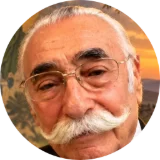
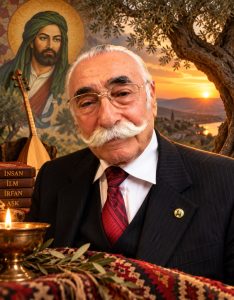
Seyyid Derviş Tur Dede was born on 10 November 1936 in Başköy, in the Çayırlı district of Erzincan province. He is an Alevi religious leader of the Babamansur Ocağı (ocak: a hereditary lineage of Alevi dedes), a researcher, author and poet. He served during the founding period of Alevi organisation in Germany and is one of the founders of the Federation of Alevi Communities (Alevi Cemaatleri Federasyonu; today the Alevi Community of Germany / Federation of Alevi Unions in Germany, AABF). From 1990 he held the federation’s chairmanship; when the federation was entered in the register of associations in Mainz on 17 January 1991, he was listed there as chairman. He was re-elected at the first ordinary general assembly on 30 May 1991 and, apart from a short interruption, held this office until October 1993; from 1994 until spring 2003 he chaired the federation’s Council of Dedes (Dedeler Kurulu).
| Born | 10 November 1936, Başköy – Çayırlı, Erzincan |
| Parents | Elif Ana and Seyyid Haydar Dede |
| Ocak | Babamansur Ocağı |
| Spouse | Zöhre Tur (married 23 April 1956) |
| Family | Three sons and seven grandchildren |
| Fields | Alevi religious services, organisation, research, writing and poetry |
| Pen name | Kemter (“the humblest one”); in some texts Fakir Kemter |
Origins and Childhood
Derviş Tur was born within the tradition of the Babamansur Ocağı in the Erzincan region. Growing up in an ocak family allowed him from childhood to witness at close hand the cems (Alevi worship ceremonies), the prayers and the understanding of görgü (accountability before the community) and rızalık (mutual consent). It was in this family and ocak environment that the religious foundation of the dede service he later performed was formed.
The family’s move to Ankara in 1950 was the first great turning point in his life. While learning a trade, he preserved the oral knowledge he had received from the Babamansur tradition. That years later he gave ample space in his works to the ocak system, genealogy, the rites of the cem and Alevi history is the result of his effort to bring together oral tradition and the need for a written record.
For him, belonging to the Babamansur Ocağı is not merely a family origin but a responsibility to serve the community.
The Ankara Years: Trade, Military Service and Memories
In Ankara he received vocational training in car repair and diesel engines. In April 1961 he began working at the Machinery Supply Department of the State Hydraulic Works (Devlet Su İşleri); working in the diesel pumps and engines section, he rose to the position of foreman. In his spare time he drove a taxi, contributing to his family’s livelihood.
He performed his military service, which began on 20 September 1957, as an official driver at the Istanbul Garrison Command. According to his own memories, during this time he was part of the team that received state dignitaries.
Among the memories told within the family is his encounter with Âşık Veysel Şatıroğlu in Ankara: he did not charge Âşık Veysel, whom he had taken in his taxi, and Âşık Veysel played his saz and sang a folk song during the journey. This memory is passed on as a precious part of Derviş Tur’s life story.
Migration to Germany and Working Life
On 15 May 1966 he went to Germany to work. His first stop was Cologne; he then lived in Hennef and Dillenburg, and on 14 March 1979 he settled in Rüsselsheim with his family. He worked as an industrial worker and in fields such as diesel engine and truck repair. He attached great importance to learning German and shared this knowledge by teaching Turkish workers in and around Hennef at weekends.
From 1969 to 1990 he worked in trade. After handing over his business to his son Erdoğan Tur in 1990, he devoted most of his time to Alevi religious services, building associations, and research and writing.
Alevi Organisation in Europe
In the second half of the 1980s, Alevis in Europe began to discuss the need for institutions that would protect their identity, their faith and their young generation. Derviş Tur was one of those who took part in the first meetings in the Rüsselsheim and Mainz area. As he relates in his book Avrupa’da İlk Alevi Yapılanması (The First Alevi Organisation in Europe), the core team that initiated the founding of associations and then the work on the federation consisted of the following people: Ahmet Aydemir, İsmail Yağlı, Derviş Tur, İsmail Elçioğlu, Sabit Yıldız, Musa Bakır and Uğur Aydoğdu. Together with his colleagues he travelled to various German cities and to Austria, supported the founding of associations, led cems, and organised seminars and information meetings.
| Date | Development |
|---|---|
| 23 February 1987 | First meeting with 15 people in Rüsselsheim; on 26 March 1987 decision to found an Alevi institution |
| 1 December 1988 | Official founding of the Mainz–Rüsselsheim–Wiesbaden Alevi Bektashi Association |
| 19 May 1990 | Adoption of the statutes and founding of the Federation of Alevi Communities (ACF; official German name “Die Vereinigung der Aleviten-Gemeinden e.V.”) (meetings in Astheim and Dortmund); chairman of the founding council Ahmet Aydemir, Derviş Tur on the founding board |
| September–November 1990 | Begins serving as chairman of the federation (signs the press statement of 14 September 1990 as “Chairman”; the federation’s board is reconstituted on 4 November 1990) |
| 17 January 1991 | The federation is entered in the register of associations of the Mainz Local Court (Amtsgericht Mainz); Derviş Tur listed in the register as chairman |
| 30 May 1991 | Ordinary general assembly of the federation (17 associations): re-elected chairman; in August 1991 publication of the journal “Mürşid” |
| 1992–1993 | The chairmanship passes briefly to İsmail Elçioğlu; after Elçioğlu’s resignation on 8 May 1993 he is elected chairman again |
| 30–31 October 1993 | Handover of the federation’s leadership at the general assembly in Frankfurt; end of his chairmanship |
| 12 March 1994 | On his proposal the federation’s Council of Dedes is founded; he chairs the council until spring 2003 |
Religious Services and Community Work
For around thirty-five years Derviş Tur led cems in different parts of Europe, served at funeral rites, organised seminars and endeavoured to pass on the fundamental concepts of the Alevi path to the new generations.
An important dimension of these services is that deceased Alevis can be laid to rest with dignity and in accordance with their own faith. Derviş Tur recognised this need early. He was the intellectual and religious pioneer of Erenler Cenaze Bestattungsinstitut, founded in December 1996 by his son Erdoğan Tur; he contributed to arranging the steps – from the preparation of the deceased to the rite of sending them off to God (Hakk’a uğurlama) – in keeping with the Alevi faith, and recorded the prayers to be recited in writing in his works. In May 2018 the institute was handed over to the Federation of Alevi Unions in Germany (AABF), and the service continued on an institutional basis.
Derviş Tur interprets Alevism within Islam in the framework of Allah–Muhammad–Ali, the Ehl-i Beyt (Ahl al-Bayt, the family of the Prophet), the Twelve Imams, the bâtınî (inner, esoteric) interpretation of the Qur’an, the ocak system, ikrar (the vow), musahiplik (spiritual kinship) and the rites (erkân) of the cem.
Writing and Research
His writing rests on the combination of the oral ocak tradition, cem services over many years, a personal archive, institutional documents and historical reading. The aim of his writing is to record lived experience and to create a memory of the path that can be handed down to future generations:
- to pass on the Alevi path and its rites (yol and erkân) to future generations in written form
- to record the lineage and service tradition of the Babamansur Ocağı
- to describe the founding period of Alevi organisation in Europe with documents and testimonies
- to set out his thoughts on Alevism’s Ehl-i Beyt-centred interpretation of Islam
In his poems and deyiş (sacred poems) he uses the pen name Kemter. Love of the Ehl-i Beyt, Karbala, Imam Husayn (Hz. Hüseyin), justice, rızalık (consent), love of humanity, and the path and its rites are the main themes of his poems.
Principal Works
- Erkânname – Aleviliğin İslam Yorumu ve Alevi Erkânları (The Alevi Interpretation of Islam and the Alevi Rites) (1st edition 2002, 2nd edition 2005, expanded 3rd edition 2012)
- Avrupa’da İlk Alevi Yapılanması – Tarihî Gerçekleri ve Seyit Derviş Tur’un Hatıraları (The First Alevi Organisation in Europe – Its Historical Facts and the Memoirs of Seyit Derviş Tur) (2016)
- İmam Rıza Türbesi ve İran Anılarım (The Shrine of Imam Reza and My Memories of Iran) – the journey to Iran that Derviş and Zöhre Tur began in April 2016
- Şah’a Giden Yol (The Path to the Shah) – Zahirî ve Bâtınî Yönleriyle Alevi İslam İnancı (The Alevi Islamic Faith in its Outer and Inner Dimensions) (2019)
- Arzuhâl (A Petition) – Erenler Meclisinin Çilekeş Kemteri, Bütün Varlığımla Yaratan’a Arzuhalim (The Long-Suffering Humblest One of the Assembly of the Erenler – My Petition to the Creator with My Whole Being) (2022)
Chronology of His Life
| Date | Development |
|---|---|
| 10 November 1936 | Born in Başköy, Çayırlı district, Erzincan |
| 1950 | Moved with his family to Ankara |
| 23 April 1956 | Married Zöhre Tur |
| 1957–1959 | Military service; official driver at the Istanbul Garrison Command |
| April 1961 | Began working at the Machinery Supply Department of the State Hydraulic Works |
| 15 May 1966 | Went to Germany; began living in Cologne |
| 1969–1990 | Worked in trade |
| 1979 | Settled in Rüsselsheim with his family |
| 1987–1988 | Took part in the founding of the Mainz–Rüsselsheim–Wiesbaden Alevi Bektashi Association |
| 1990 | One of the founders of the Federation of Alevi Communities; elected chairman on 4 November 1990; handed over his business |
| 30 May 1991 | Re-elected chairman at the federation’s ordinary general assembly (official recognition: 17 January 1991) |
| October 1993 | Handed over the federation’s leadership; end of his chairmanship |
| 1994–2003 | Chairman of the federation’s Council of Dedes |
| December 1996 | Erenler Cenaze Bestattungsinstitut founded; he contributed its religious content |
| 2002 | First edition of the Erkânname published |
| 2012 | Expanded third edition of the Erkânname published |
| 2016 | “Avrupa’da İlk Alevi Yapılanması” published; journey to Iran |
| 2019 | “Şah’a Giden Yol” published |
Assessment
The life of Seyyid Derviş Tur Dede can be read along three main lines: religious service rooted in the Babamansur Ocağı; the experience of labour and migration stretching from Turkey to Germany; and organisational work in the first years of Alevi institution-building in Europe. His life – ranging from technical craftsmanship to teaching, from trade to the service of a dede and to writing – makes visible the transformation of the first generation of European Alevism.
A religious leader and author who put the oral ocak tradition into books, who was among the founding workers of the first institutional Alevi organisation in Europe, and who has sought to leave his life’s testimony to future generations.
Source: the published works and family archive of Seyyid Derviş Tur Dede (biographical working text, August 2026). To read the detailed life story in his own words: Life Story »
In the Press, on Television and in Academic Research
The work of Seyyid Derviş Tur Dede has also featured in independent media and scholarly publications:
- 1991 – Interview by Suat Türker in Hürriyet: “Alevi Cemaatleri Federasyonu Başkanı Derviş Tur: Aleviler örgütleniyor” (“Derviş Tur, Chairman of the Federation of Alevi Communities: The Alevis are organising”) (25 January 1991).
- 1991 – Milliyet: the federation’s statement protesting against pro-sharia speeches in Cologne, “Alevilerden tepki” (“Reaction from the Alevis”) (May 1991).
- 1997 – Milliyet’s series “Dönemecin Eşiğinde: Aleviler” (“At the Turning Point: The Alevis”): “Yeni nesil uğruna” (“For the Sake of the New Generation”) (Özcan Ercan, 28 October 1997); Tur was introduced as “the Chief Dede of Europe’s Alevis and the architect of the organisation”.
- 2002 – Took part on behalf of the AABF in the interreligious peace meeting in Assisi convened by Pope John Paul II.
- 2013 – Anadolu Agency: “Seyit Derviş Tur’dan ‘Oyuna gelmeyin’ çağrısı” (“Seyit Derviş Tur’s call: ‘Don’t be taken in’”) (23 June 2013).
- 2016 – TRT Haber, “Ömür Dediğin” (What We Call a Life), Episode 108: “Zöhre – Derviş Tur / İzmir”.
- 2014 – Comprehensive interview with the writer and researcher Ayhan Aydın on his life, the dede tradition, organisation in Germany and his understanding of Alevism.
- 2023 – Met readers with his books at the Didim Writers’ Festival.
- 2025 – Spoke on Alevism, Islam, education and social unity at the programme “Anadolu İrfanının Eğitime Katkıları” (“The Contributions of Anatolian Wisdom to Education”).
- Academic publications – Martin Sökefeld (2005), Zeynel Gül (2002), Burak Gümüş (2008), Bülent Keleş (2024) and other studies discuss him, his works and his role in Alevi organisation in Europe.
- Institutional records – Person and author records exist in the AABF history archive, the German National Library (GND), VIAF and Wikidata.
For direct links to press reports, interviews, videos, library records and scholarly studies: Seyit Derviş Tur in the Press, Media and Academic Sources · Summary of sources in German: Presse, Medien und Forschung · Video recordings: Videos
Translated from the Turkish original by Seyit Derviş Tur.