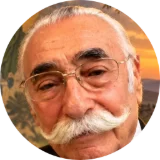
In brief: Virani (Viran Abdal) was a poet who lived in the second half of the 15th and at the beginning of the 16th century, in the time of Balım Sultan, and who is counted in the Alevi tradition among the Seven Great Poets (Yedi Ulu Ozan). A divan (collected volume) of about three hundred of his poems survives; the great majority of his poems praise Imam Ali and the Twelve Imams. This page contains Seyit Derviş Tur Dede’s assessment of Virani’s relationship to Hurufism and of his poem “Nusayri’yem”, together with examples of his poetry.
The following text is taken from Seyit Derviş Tur Dede’s book Erkânname. For a general introduction: What is Alevism?
Who was Virani?
Virani is a distinguished poet who is counted among the Seven Great Poets within the Alevi community and is remembered with great reverence. We have no definite or satisfactory information about where Virani came from, when he was born or how he lived. The real name of this poet, who used the pen name (mahlas) Viran Abdal, is unknown. We know only that there is a divan bringing together three hundred of his poems. This divan, too, reveals little about his life.
In the deyiş (sacred songs) and poems that Virani wrote, he indicates that he lived in the time of Balım Sultan, and in his deyiş he also expresses his devotion to Balım Sultan. He states that he served in the dergâh (lodge) of Seyyid Ali Sultan in Macedonia, where Balım Sultan was raised. Based on the information his poems provide, it can be said that he lived in the second half of the 15th century and the early 16th century.
Was Virani a Nusayri?
According to some authors, Virani belonged to the “Nusayri” order, which recognises Ali as God, and they describe him as a Nusayri poet. Normally, Alevi poets emphasise that Imam Ali possessed supernatural, superhuman powers. Although Virani’s understanding is not very different from this general tendency, the fact that he expresses this belief openly, and even shows in his poem that he adopts this designation as a word for himself, has given rise to such an opinion among authors. In fact, adherents of the Nusayri faith maintain that Imam Ali had no descendants and could not have had any. Virani, by contrast, praised the Twelve Imams, Hacı Bektaş Veli and his descendants in almost every one of his poems and declared his devotion to them. Nevertheless, almost the entirety of Virani’s poems consists of poems praising and exalting Imam Ali.
Virani and Hurufism
It is also said that Virani was a Hurufi. The term Hurufi, derived from the word “huruf”, meaning “letters”, became the name given to those who believe that God manifests Himself in the form of the word and is expressed through letters. Fazl-ullah (1363–1401), son of Ebu Muhammed of Tabriz, holds in his historically famous work “Cavidan-Name” (The Book of Eternity) that the letters of the Quran are connected with the human face, and that the meaning of the Quran has taken shape in the human face. Because this doctrine was interpreted in a manner inclined towards the philosophy of tasavvuf (Islamic mysticism), it also found its place in mystical philosophy.
For this reason Fazl-ullah became widely famous under the name Hurufi and became a source of inspiration for many poets. Interpreting this belief according to the numbers of letters in the verses of the Quran and the shapes in the human face, Fazl-ullah tried to prove that man was created in the image of God (Hak) and that God exists out of man. Hurufism, which expresses the belief that the Book of God has taken shape in the human face and which developed into a poetic art formed from all the letters, was mentioned by every poet of that era and given a place in their poems. Virani’s thought and interpretation in this direction gained considerable acceptance and followers in mystical philosophy. (On Hurufism see also: Seyyid Nesimi.)
Virani does not claim to be a man of literature and poetic art like the other poets of mystical literature. His aim is to convey the loftiness and sanctity of his faith and to make it heard by as many people as possible through beautiful expression and verse. It can safely be said that he achieved great success in this. Virani has a large share in turning people towards sublime feelings.
Virani’s poems
Serdarımız Seyyid Ali (Our leader is Seyyid Ali)
A poem that is important for showing the era in which Virani lived, and in which he praises Seyyid Ali Sultan, under whose spiritual guidance (irşad) he stood, and his erenler (saints):
Biz Urum abdalıyız serdarımız Seyyid Ali
Çeşmimizde şu’lei envârımız Seyyid Ali
Bülbül’ü Şeyda biziz gül zarımız Seyyid Ali
Dinimiz imanımız ikrarımız Seyyid Ali
Nur’u Ahmet Haydar’ı kerrârımız Seyyid Ali
Kanda baksak dembedem didarımız Seyyid Ali
We are the abdals of Rum (Anatolia); our leader is Seyyid Ali.
In our eye the radiance of our lights is Seyyid Ali.
We are the love-crazed nightingale; our rose garden is Seyyid Ali.
Our religion, our faith, our vow (ikrar) is Seyyid Ali.
The light of Ahmad, our ever-returning Haydar (Ali), is Seyyid Ali;
wherever we look, at every moment, our beloved’s face is Seyyid Ali.
Zahide şek şüphe yoktur Evliya’nın râhına
Cenneti alaya girer yüz süren dergâhına
Bu kelâmı vird idüp Şam’ü seherde ahına
Gel beru ermek istersen ol erenler şahına
Nur’u Ahmet Haydar’ı kerrârımız Seyyid Ali
Kanda baksak dembedem didarımız Seyyid Ali
O pious ascetic, there is no doubt about the path of the saints;
whoever lays his face at their dergâh enters the highest paradise.
Make this word your litany, in your sighs at evening and at dawn;
come hither if you wish to reach that king of the erenler.
The light of Ahmad, our ever-returning Haydar, is Seyyid Ali;
wherever we look, at every moment, our beloved’s face is Seyyid Ali.
Ey Viranı dâmenin elden koma Şah’ın müdam
Ta olasın gün be gün Şah’ın yolunda müstedam
Hub-bi evlâdın hakkıyçün eylegil anı tamam
Ki bu methi yâd eder şâm’u seherde yâ İmam
Nur’u Ahmet Haydar’ı kerrârımız Seyyid Ali
Kanda baksak dembedem didarımız Seyyid Ali
O Virani, never let go of the hem of the Shah,
so that day by day you may remain steadfast on the Shah’s path.
For the sake of love for his descendants, bring it to completion,
for this praise remembers at evening and at dawn: “O Imam!”
The light of Ahmad, our ever-returning Haydar, is Seyyid Ali;
wherever we look, at every moment, our beloved’s face is Seyyid Ali.
Nusayri’yem (I am a Nusayri)
The famous poem that is the reason why Virani is called a Nusayri:
Gel istersen saadet sonu hayrı
Nazar kıl can gözüyle gör bu seyri
Gözün aç bak ne var âlemde ayrı
Hemen dem Şah’ı gör hiç görme gayrı
Nusayri’yem, Nusayri’yem, Nusayri
Ne ölmüşem ne hod sağım ne sayrı
Come, if you wish for bliss and a good end;
look with the eye of the soul and see this spectacle.
Open your eyes and see what is separate in the world;
see the Shah at every moment, see nothing else.
I am a Nusayri, I am a Nusayri, a Nusayri;
I am neither dead nor alive nor sick.
Ali’dir âlem-ül gaybın sıfatı
Ki gösterdi sıfat içinde zatı
Dilersen içersin Abu hayatı
Bu sırra kim erer görmez melâmatı
Nusayri’yem, Nusayri’yem, Nusayri
Ne ölmüşem ne hod sağım ne sayrı
Ali is the attribute of the unseen world,
who revealed the essence within the attribute.
If you wish, you will drink the water of life;
whoever attains this secret suffers no reproach.
I am a Nusayri, I am a Nusayri, a Nusayri;
I am neither dead nor alive nor sick.
Ali’dir Padişah’ı aleme server
Anın destindedir cennât’ü Kevser
Kıyamet kaddidir mihrab’ü minber
Vücudum anadır ser cümle yekser
Nusayri’yem, Nusayri’yem, Nusayri
Ne ölmüşem ne hod sağım ne sayrı
Ali is the sovereign, the chief of the world;
in his hand are the gardens of paradise and the Kevser (the paradise spring).
His stature is the Resurrection, the mihrab and the minbar;
my being belongs to him, wholly, from head to foot.
I am a Nusayri, I am a Nusayri, a Nusayri;
I am neither dead nor alive nor sick.
Ali’dir var eden Arz’ı semayı
Dahi hem Nur’u şemsi Gün’ü ayı
Koma zikret Hasan Hulki Rıza’yı
Dilersen Şah Hüseyin’i Kerbela’yı
Nusayri’yem, Nusayri’yem, Nusayri
Ne ölmüşem ne hod sağım ne sayrı
Ali it is who created the earth and the heavens,
and also the light of the sun, the day and the moon.
Do not fail to praise Hasan, the gentle and content,
and, if you wish, Shah Hüseyin and Karbala.
I am a Nusayri, I am a Nusayri, a Nusayri;
I am neither dead nor alive nor sick.
Ali’dir Abidin Bakır’ı Cafer
Eden inkâr olur merdud’i kâfir
Ali aşkı kimi kim kıldı Per ver
Memat olmaz bilin diridir ol er
Nusayri’yem, Nusayri’yem, Nusayri
Ne ölmüşem ne hod sağım ne sayrı
Ali is Abidin, Bakır and Cafer;
whoever denies it becomes a rejected unbeliever.
Whomever the love of Ali has given wings
does not die – know that that man is alive.
I am a Nusayri, I am a Nusayri, a Nusayri;
I am neither dead nor alive nor sick.
Ali’dir Kazim’i Şah’ı Horasan
Anınçün bilmek olmaz bu sırrı insan
Huda dedim Ali’ye ol dem ey can
Beni yetmiş iki kez kıldı kurban
Nusayri’yem, Nusayri’yem, Nusayri
Ne ölmüşem ne hod sağım ne sayrı
Ali is Kâzım and the Shah of Khorasan (Rıza);
that is why man cannot know this secret.
At that moment, O soul, I called Ali God (Huda),
and I was sacrificed seventy-two times.
I am a Nusayri, I am a Nusayri, a Nusayri;
I am neither dead nor alive nor sick.
Ali’dir Şah Taki vü Ba Naki hem
Ali halik derim hiç söylemem kem
Ol öldürdü ol oldu derdime merhem
Nazirin yokdürür ey Şah’ı Âlem
Nusayri’yem, Nusayri’yem, Nusayri
Ne ölmüşem ne hod sağım ne sayrı
Ali is Shah Taki and Naki as well;
I call Ali the Creator and never speak less of him.
He it was who slew, and he became the balm for my pain;
you have no equal, O Shah of the world.
I am a Nusayri, I am a Nusayri, a Nusayri;
I am neither dead nor alive nor sick.
Ali’dir Askeri Mehdi hidayet
Zuhur ettik de def ola cehalet
Yezidi’n başına koptu kıyamet
Göründü emri Yezdan dan alâmet
Nusayri’yem, Nusayri’yem, Nusayri
Ne ölmüşem ne hod sağım ne sayrı
Ali is Askeri, is Mehdi, the true guidance;
we have appeared so that ignorance may be driven away.
Doomsday has broken over the head of Yazid;
a sign from the command of God (Yezdan) has appeared.
I am a Nusayri, I am a Nusayri, a Nusayri;
I am neither dead nor alive nor sick.
Ali’dir kün deyüb var etti canı
Eğer cism ile canı dü cihanı
Yürü insan isen sen Şahı tanı
Nusayri’yem, Nusayri’yem, Nusayri
Ne ölmüşem ne hod sağım ne sayrı
Ali it is who said “Be!” (kün) and created the soul,
whether body or soul, both worlds.
Go, if you are human, recognise the Shah!
I am a Nusayri, I am a Nusayri, a Nusayri;
I am neither dead nor alive nor sick.
Virani’yem bu yolda can verirem
Ali’ye aşk ile akl ile olmuşam yarem
Nusayri ‘yem ki ben Ali’ye uyarem
Gerek bu can zerre yü olsa parem
Nusayri’yem, Nusayri’yem, Nusayri
Ne ölmüşem ne hod sağım ne sayrı
I am Virani; on this path I give my life;
with love and with reason I have become wounded for Ali.
I am a Nusayri, for I follow Ali,
even if this soul should be torn into atoms.
I am a Nusayri, I am a Nusayri, a Nusayri;
I am neither dead nor alive nor sick.
In this beyit Virani openly states that he is a Nusayri and that, in accordance with his faith, he believes that Imam Ali represents God in human form.
Ya Muhammed ya Ali (O Muhammad, O Ali)
Mazhar’ı Nuri hüdasın ya Muhammed ya Ali
Hemdem’i Şahi evliyasın ya Muhammed ya Ali
You are the place where the divine light is manifest, O Muhammad, O Ali;
you are the companion of the Shah of the saints, O Muhammad, O Ali.
Hem Hatice Fadime Hulki Rıza’nın hakkıçün
Gözlerime rüşenasın ya Muhammed ya Ali
For the sake of Khadija, Fatima and the gentle, content one (Hasan),
you are the light of my eyes, O Muhammad, O Ali.
Ben Hüseyin’in bendesinin bendesiyim bendesi
Bilmişim Zeynal aba’sın ya Muhammed ya Ali
I am the servant of the servant of the servant of Hüseyin;
I have come to know that you are Zeynel (Abidin) and the People of the Cloak (Ehl-i Aba), O Muhammad, O Ali.
Bakır’ı Cafer yolunda canımı kılmak feda
İsterim virgül şuhasın ya Muhammed ya Ali
To sacrifice my life on the path of Bakır and Cafer
is my wish; you are … (line unclear), O Muhammad, O Ali.
Kazım’ı Musa Rıza vü hem Tâki vü bâ Naki
Ebecd’i Ali abasın ya Muhammed ya Ali
Musa Kâzım, Rıza, and also Taki and Naki –
you are the abjad (the alphabet) of the Ehl-i Aba, O Muhammad, O Ali.
Askeri hem Mehdi sahibi zamanın hürmetine
Cürmünü affet atasın ya Muhammed ya Ali
For the honour of Askeri and Mehdi, the Lord of the Age,
forgive the sin – you are the fathers, O Muhammad, O Ali.
Bu Viran Abdal garibin derdine derman dişen
Gayrı yoktur senden davasın ya Muhammed ya Ali
You are the cure for the pain of this poor stranger, Viran Abdal;
there is no other remedy but you, O Muhammad, O Ali.
Caferi’yim (I am a Jafari)
In this beyit, too, Virani relates that he belongs to the Jafari (Caferi) school of law and is bound to the Twelve Imams.
Dinle indi nutku kim ne derim ey din eri
Sevmişem canu gönülden Mustafa’yu Haydar’ı
Gezmezem hergiz cihanda serseri vü serseri
Caferi’yim, Caferi’yim, Caferi’yim, Caferi
Listen now to my words, to what I say, O man of faith:
with all my soul and heart I have loved Mustafa and Haydar.
Never do I wander aimless and astray through the world –
I am a Jafari, I am a Jafari, I am a Jafari, a Jafari.
Şah Hasan Hulki Rıza vü Şahi Hüseyin’i Kerbela
Zeynal Abidin’i Bakır’u Kazım Ali Musa Rıza
Bende’i Ali Abayım hanedana mübtela
Caferi’yim, Caferi’yim, Caferi’yim, Caferi
Shah Hasan, the gentle and content, and Shah Hüseyin of Karbala,
Zeynel Abidin, Bakır, Kâzım, Ali Musa Rıza –
I am a servant of the Ehl-i Aba, devoted to the House (of the Prophet);
I am a Jafari, I am a Jafari, I am a Jafari, a Jafari.
Hem Muhammed Taki tacım serimde Şah var
Bulmuşam Nuri Naki’den din’i millet aşikâr
Naletim vardır dilimde, ol Yezid’e set hazar
Caferi’yim, Caferi’yim, Caferi’yim, Caferi
Muhammad Taki is my crown; upon my head is the Shah;
in the light of Naki I have found religion and community made manifest.
On my tongue is my curse – a hundred thousand times upon that Yazid;
I am a Jafari, I am a Jafari, I am a Jafari, a Jafari.
Ben Gulam’i Kanber’im Kanber gulami Askeri
Dü cihanın Mehdi dir bil aftabi enveri
Dört kitabı söylerem aynı cemalin Askeri
Caferi’yim, Caferi’yim, Caferi’yim, Caferi
I am the servant of Kanber; Kanber is the servant of Askeri;
know that the most radiant sun of both worlds is Mehdi.
I proclaim the four Books, which are the very countenance of Askeri;
I am a Jafari, I am a Jafari, I am a Jafari, a Jafari.
Can fanidir ey Gulami ilmü kudret Cavidan
Fazlı Hak’tır bu rumuzu andan olmuştur beyan
Biz güruhu Naci’yiz söyler zebanım her zaman
Caferi’yim, Caferi’yim, Caferi’yim, Caferi
The soul is mortal, O servant; knowledge and power are eternal (cavidan).
Fazl is truth; from him this symbol has been made known.
We are the company of the saved – so my tongue says at all times;
I am a Jafari, I am a Jafari, I am a Jafari, a Jafari.
… Ali’mdir Ali (… it is my Ali, Ali)
İstemem âlemde gayrı meyvayı
Dadına doyulmaz balımdır Ali
İstemem Dünya’yı verseler dahi
Kokmazam sümbülü gülümdür Ali
I want no other fruit in the world;
Ali is my honey, whose taste one never tires of.
I do not want the world, even if they gave it to me;
I do not smell the hyacinth – Ali is my rose.
Ali’mdir kadehim, Ali’mdir şişe
Ali’mdir sahralarda morlu menekşe
Ali’m dolu verdi iklim dört köşe
Ali’m saki Kevser dolumdur Ali
My Ali is my cup, my Ali is the flask,
my Ali is the purple violet in the fields.
My Ali has filled the four corners of the world with abundance;
my Ali is the cupbearer – Ali is my cup from the Kevser.
Ali vahid şahı, Resul Kibriya
İmam Hasan Şah Hüseyin’i Kerbela
İmam Zeynel Aba ol sahibi liva
Büküldü kametim dalımdır Ali’m
Ali is the one Shah, the Messenger (is the envoy) of the divine majesty;
Imam Hasan, Shah Hüseyin of Karbala,
Imam Zeynel, (one of) the Ehl-i Aba, that lord of the banner –
my stature is bent; my Ali is my branch.
Muhammed Bakır’dır tendeki canım
Cafer’i Sadık’tır dinim imanım
Musa’yı Kazım’dır derde dermanım
Varlığım kalmadı malımdır Ali’m
Muhammad Bakır is the soul in my body,
Cafer-i Sadık is my religion and my faith,
Musa-i Kâzım is the cure for my pain;
my possessions are gone – my Ali is my wealth.
Ali’yül Rıza’dır şahı Horasan
Taki ile Naki gösterdi burhan
Hasan’ül Asker’i mâhi dırahşan
Yokladım halimi falımdır Ali’m
Ali Rıza is the Shah of Khorasan;
Taki and Naki showed the proof;
Hasan Askeri is the shining moon.
I have examined my state – my Ali is my fate.
Muhammed Mehdi’dir sahibi zaman
On iki İmam’a kul oldum heman
Masumu paklardır envari cihan
Esrarı Huda da Ali’mdir Ali’m
Muhammad Mehdi is the Lord of the Age;
at once I became a servant of the Twelve Imams.
The pure innocents are the lights of the world;
in the mysteries of God, too, it is my Ali, my Ali.
Virani’yem düştüm her an derdine
Vucudum garkoldu çile bendine
Gönül sormaz oldu kendi kendine
Söyler dehanımdan dilimdir Ali’m
I am Virani; at every moment I have fallen into his sorrow;
my being has sunk into the bonds of trial (çile).
The heart no longer questions itself;
it speaks from my mouth – my Ali is my tongue.
Source: Seyit Derviş Tur, Erkânname – Aleviliğin İslam Yorumu ve Alevi Erkânları (Erkânname – The Alevi Interpretation of Islam and the Alevi Rites), expanded 3rd edition (ISBN 975-6791-52-7).
More articles on Alevism
Faith and erkân
- What is Alevism? (main page)
- What does Kızılbaş mean? Who is called an Alevi?
- The Four Gates and Forty Stations in Alevi belief
- What is ikrar (the vow), and where does it come from?
- Islam and Alevi belief
- The meaning of the word “Islam” and its distortion
- The place of women in Alevi belief
- The Fourteen Pure Innocents and the Seventeen Kemerbest
Cem and rites
- What is a Cem? The cemevi, its rules and the twelve services
- What is the semah? The sanctity of the semah
- What is musahiplik (spiritual kinship), and where does it come from?
- The görgü rite (görgü cem)
- Alevi funeral rites
- Alevi marriage rites
- What is düşkünlük (excommunication)?
Festivals, fasts and holy days
- The month of Muharram and the sanctity of the fast
- Hızır İlyas
- Nevruz among the Alevis
- The Feast of Sacrifice (Kurban Bayramı)
The Twelve Imams
- Who are the Twelve Imams?
- Imam Ali
- Imam Hasan
- Imam Husayn
- Imam Zayn al-Abidin
- Imam Muhammad al-Baqir
- Imam Jafar al-Sadiq
- Imam Musa al-Kazim
- Imam Ali al-Rida
- Imam Muhammad al-Taqi
- Imam Ali al-Naqi
- Imam Hasan al-Askari
- Imam Mahdi
The Seven Great Poets
- Who are the Seven Great Poets (Yedi Ulu Ozan)?
- Seyyid Nesimi
- Şah İsmail Hatayi
- Fuzuli
- Yemini
- Pir Sultan Abdal
- Kul Himmet
- Noksani Baba
History: Ehl-i Beyt, Ghadir Khumm and Karbala
Books and Alevi organisation in Europe
- Erkânname
- The first Alevi organisation in Europe (memoirs)
- Alevi Islam – The Path to the Shah
- All books
In German: Alevitentum: Grundlagen, Glaube und zentrale Begriffe · Geschichte der Aleviten-Organisation in Deutschland
About the author: Seyit Derviş Tur Dede
Born in 1936 in Başköy (Çayırlı, Erzincan) into a seyyid family belonging to the Babamansur (Şah Mansur) ocak. He is a co-founder and the first chairman (1990–1993) of the Federation of Alevi Communities, the forerunner of the Alevi Federation of Germany (AABF). From 1994 to 2003 he chaired the Council of Dedes within the federation. Erkânname (2002) and Avrupa’da İlk Alevi Yapılanması (2016); his work is cited as a source in academic publications by researchers such as Martin Sökefeld, Zeynel Gül, Burak Gümüş and Bülent Keleş.
Translated from the Turkish original by Seyit Derviş Tur.